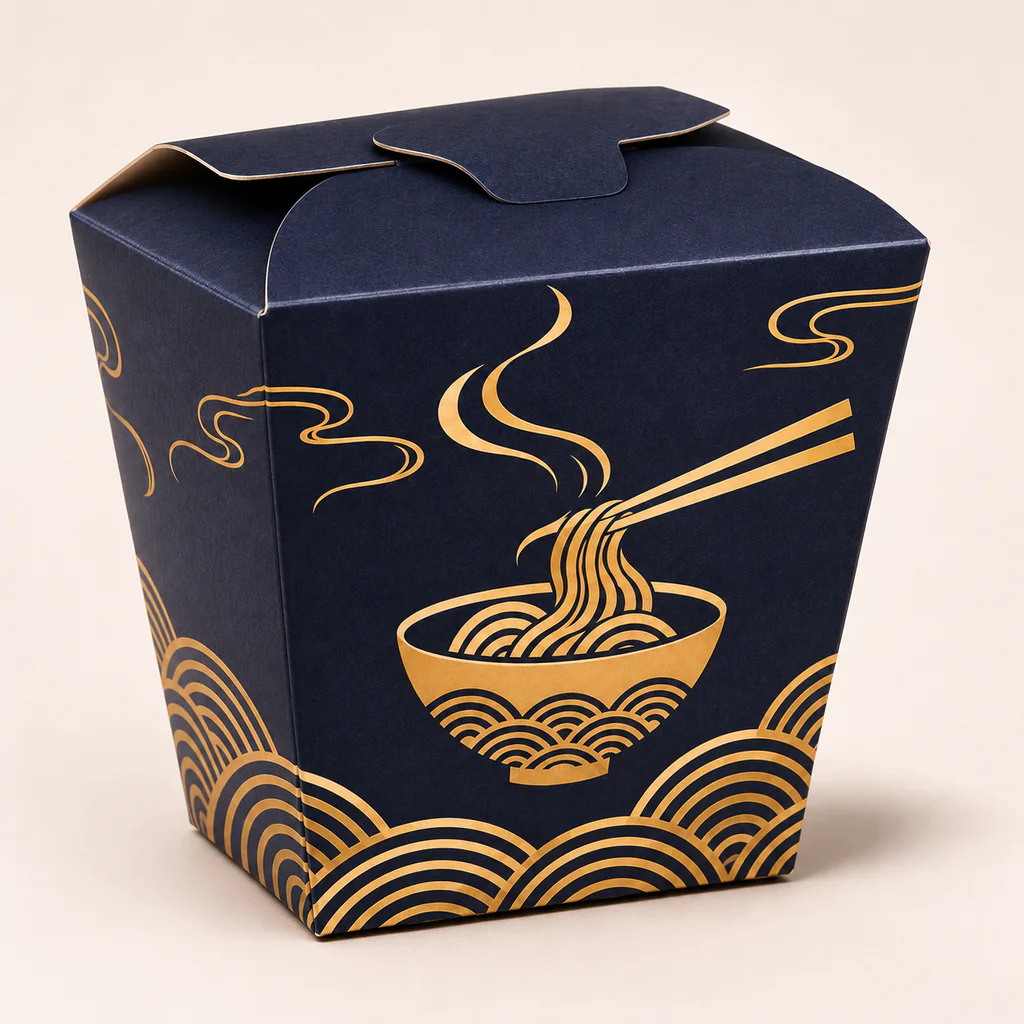
Tapered fold-top carton
Compact footprint and interlocking top flaps.
Food and Takeaway Packaging
A noodle box is a tapered takeaway carton sized to a portion of noodles and its sauce or toppings. It uses a closure suited to service and delivery.
From $0.79 per box
Price for 1 box at 4 × 3 × 4 in (102 × 76 × 102 mm), in Food-contact board, with full-color digital print on the outside.
| Quantity | Per box | Total |
|---|---|---|
| 1 | $0.79 | $0.79 |
| 100 | $0.79 | $79.00 |
| 250 | $0.79 | $197.50 |
| 500 | $0.79 | $395.00 |
| 1,000 | $0.79 | $790.00 |
| 2,500 | $0.79 | $1,975.00 |
| 5,000 | $0.79 | $3,950.00 |
Printed takeaway cartons for noodles and similar warm portions, specified around contact, steam and serving time.
A lightly coated stir-fry and a saucy noodle dish need different seam and barrier performance. Sample the actual dish at packing temperature and keep separate liquid containers where needed.
Our custom noodle boxes are part of the food and beverage packaging range alongside our custom bakery boxes. Compare all 236 custom box types, or see how Custom Boxes makes printed packaging from one box.
Reverse tuck end · RTE
The standard construction for custom noodle boxes is the reverse tuck end (RTE). Top and bottom tuck flaps close from opposite faces, so the carton prints and glues in one pass. It suits cosmetics, supplements and light retail products.
Compact footprint and interlocking top flaps.
Use where a broad opening helps fill and serve the dish.
| Box style | Reverse tuck end (RTE) |
|---|---|
| Print methods | Digital CMYK, Offset litho, Flexographic spot color |
| Finishes for this box | Exterior print, Barrier where specified |
| Minimum order | 1 box per size and artwork |
| Digital proof | Within 24 hours of receiving artwork |
| Production time | 8–12 business days after artwork approval |
| Shipping | Free standard shipping across the US, 3–6 business days, tracked |
| Returns | Free returns within 21 days of delivery |
The size buyers ask for most is 4 × 3 × 4 in (102 × 76 × 102 mm), used for compact noodle portion. The smallest size listed here is 4 × 3 × 4 in (102 × 76 × 102 mm) (compact noodle portion) and the largest is 6 × 4 × 3 in (152 × 102 × 76 mm) (wide portion with toppings). Every box is cut to your own inside dimensions, so treat these as starting points rather than fixed sizes.
| Inside size (L × W × D) | What fits |
|---|---|
| 4 × 3 × 4 in (102 × 76 × 102 mm) | Compact noodle portion |
| 6 × 4 × 3 in (152 × 102 × 76 mm) | Wide portion with toppings |
| 3.25 × 2.5 × 3.25 in (83 × 64 × 83 mm) | Compact size: compact noodle portion, travel or sample size |
| 5 × 3.75 × 5 in (127 × 95 × 127 mm) | Larger size: compact noodle portion with an insert or extra room |
Fill a folded sample with the noodles your staff portion, using the normal tongs or ladle. Check whether the sides leave room for the tool to turn without catching a flap. A broad noodle can bridge the opening while a loose portion settles near the bottom. Use an inner liner unless you have confirmed the selected board is suitable for direct food contact, and include it during the trial.
Try the lid with the fullest serving in place. A noodle or garnish can catch between two overlapping folds if the portion sits near the top. Make a note of how far staff can fill it while still closing it without pressure. If broth or sauce goes separately, pack it in the sealed container you use now and check its position in the bag.
Set the order on a small table and open the flaps in the order a customer will see them. Check whether the sides give enough room for chopsticks or a fork to reach the corners. A tall tapered pack can be easy to carry and awkward to eat from. Try a wider carton if you serve large pieces that need to be lifted out without tipping the package.
For a driver order, place the sample beside its usual sides and drinks. Check whether the top stays shut when the bag is carried and set down. Open it after the time the meal usually spends in the bag. Look at the folds and base as well as the food. If a wrapper or insert has shifted, move it before checking a second size.
An order name can sit on the flap that remains visible when all of the other panels are folded. Mark that panel on a sample before laying out artwork. If staff use stickers, apply one with the actual order code and see whether it blocks the opening. We print the text exactly as supplied. Have it reviewed before sending artwork, including any copy that changes with the dish.
Print the main mark on a face that stays visible when cartons are held by the sides. Check it after the box has been filled, since a panel that bows can change how a border reads. For delivery and counter versions, use the same visible mark if customers should recognize both. Keep any size code where the person filling the order can read it at a glance.
Inspect seam moisture and base shape after handling.
Use a suitable sealed container where the dish includes broth.
Still deciding? The custom box FAQ answers the questions buyers ask most before ordering. Total an order with the packaging cost calculator, or compare formats on the custom box price list.
Pricing for custom noodle boxes starts at $0.79 per box for 1 box at 4 × 3 × 4 in (102 × 76 × 102 mm), in Food-contact board, with full-color digital print on the outside. The listed price is per box, in the standard specification, at any listed quantity. Larger runs, other boards and finishes are quoted.
After you send artwork, a digital proof comes back within 24 hours, and design help on the dieline is free. Production of custom noodle boxes takes 8–12 business days once the proof is approved. Standard shipping across the US is free and takes 3–6 business days, with tracking.
For production runs in the thousands, see wholesale custom boxes, compare every format on the custom box price list, or request a quote for custom noodle boxes.