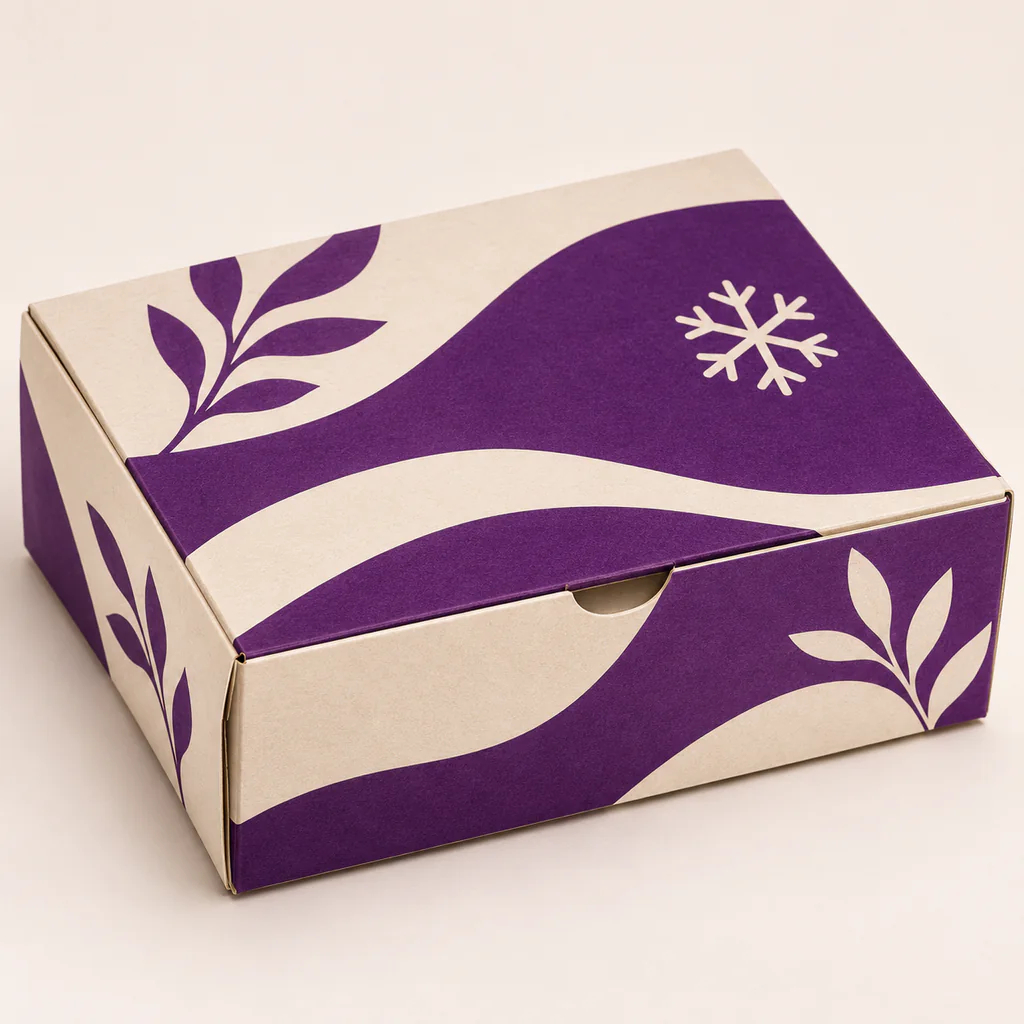
Tuck carton for a sealed tray
Use a close fit around the primary food container.
Food and Takeaway Packaging
A frozen food box is a carton made for freezer storage or secondary frozen product packaging. Its board, coating and glued seams are selected for the intended moisture and temperature cycle.
From $0.99 per box
Price for 1 box at 7 × 5 × 2 in (178 × 127 × 51 mm), in Freezer-suitable paperboard, with full-color digital print on the outside.
| Quantity | Per box | Total |
|---|---|---|
| 1 | $0.99 | $0.99 |
| 100 | $0.99 | $99.00 |
| 250 | $0.99 | $247.50 |
| 500 | $0.99 | $495.00 |
| 1,000 | $0.99 | $990.00 |
| 2,500 | $0.99 | $2,475.00 |
| 5,000 | $0.99 | $4,950.00 |
Cartons for sealed frozen products, designed around the cold chain, condensation and shelf requirements.
A freezer shelf carton serves a different purpose from an insulated shipper. Paperboard keeps the sellable item organized, while an insulated shipping system manages transit temperature. A frozen product may need both.
Our custom frozen food boxes are part of the food and beverage packaging range alongside our custom bakery boxes. Compare all 236 custom box types, or see how Custom Boxes makes printed packaging from one box.
Tray · TRAY
The standard construction for custom frozen food boxes is the tray (TRAY). An open tray with folded corner walls, used alone or inside a sleeve. It suits food, retail trays and inner packaging.
Use a close fit around the primary food container.
Consider a glued closure for a repeatable packing line.
| Box style | Tray (TRAY) |
|---|---|
| Print methods | Digital CMYK, Offset litho, Flexographic spot color |
| Finishes for this box | Exterior print, Moisture-tolerant coating where suitable, Unprinted glue areas |
| Minimum order | 1 box per size and artwork |
| Digital proof | Within 24 hours of receiving artwork |
| Production time | 8–12 business days after artwork approval |
| Shipping | Free standard shipping across the US, 3–6 business days, tracked |
| Returns | Free returns within 21 days of delivery |
The size buyers ask for most is 7 × 5 × 2 in (178 × 127 × 51 mm), used for A sealed single-portion meal tray. The smallest size listed here is 7 × 5 × 2 in (178 × 127 × 51 mm) (A sealed single-portion meal tray) and the largest is 10 × 7 × 3 in (254 × 178 × 76 mm) (A larger sealed frozen assortment). Every box is cut to your own inside dimensions, so treat these as starting points rather than fixed sizes.
| Inside size (L × W × D) | What fits |
|---|---|
| 7 × 5 × 2 in (178 × 127 × 51 mm) | A sealed single-portion meal tray |
| 10 × 7 × 3 in (254 × 178 × 76 mm) | A larger sealed frozen assortment |
| 5.5 × 4 × 1.5 in (140 × 102 × 38 mm) | Compact size: A sealed single-portion meal tray, travel or sample size |
| 8.75 × 6.25 × 2.5 in (222 × 159 × 64 mm) | Larger size: A sealed single-portion meal tray with an insert or extra room |
Measure a frozen sample with its film and seal intact. A flange that looks thin can still catch a side flap during loading. Check the tray from both ends and include any corner that projects beyond the body. Use an inner liner unless you have confirmed the selected board is suitable for direct food contact. If a sealed bag is the primary pack, measure it after the contents have settled and frozen.
A bag can have one thick corner where loose pieces collect. Put that corner in the sample and check what happens when the carton stands upright. A folded end stop can hold a tray steady if it contacts the rim and leaves the seal alone. Try removing the pack from the carton after it has been in the freezer so you can see whether a flap still opens easily.
A freezer aisle, a staging cart and a delivery bag expose the same carton to different conditions. Take a packed sample through the sequence you use, and look at the base and glued seam at each step. Note where you see moisture or a soft panel. A tight fit in the outer case can make a soft edge difficult to pull free, even if the individual carton looked fine when closed.
Keep the case pack in the trial. If a row of retail cartons is loaded with one end down, see which faces carry the load after the case moves. Make sure staff can lift one out without prying at the end closure. Leave the tray or bag sealed throughout the check. Its folds and edges need to be in the same places as they are during real packing.
A shallow carton often shows its end first when stored flat. Put the product name on that face if it must identify the item under a stack. Try reading a folded proof under the light used in the freezer. We print the text exactly as supplied. Have it reviewed before sending artwork, including wording that changes between portions or fits on a narrow face.
Leave a clear spot for any label you attach after packing. Try the label where it will actually go, then place the sample in its display case or carton. A corner may hide a small printed code when boxes sit close together. Keep the design clear of the opening edge so that the front remains readable when someone pulls the box out by its tab.
Confirm whether the food has an inner bag or tray.
Check glue seams, print rub and panel strength after condensation.
If your launch date is close, rush production shortens the production time on most corrugated formats. Want to feel the board and finishes first? Order a free sample pack before you commit.
Pricing for custom frozen food boxes starts at $0.99 per box for 1 box at 7 × 5 × 2 in (178 × 127 × 51 mm), in Freezer-suitable paperboard, with full-color digital print on the outside. The listed price is per box, in the standard specification, at any listed quantity. Larger runs, other boards and finishes are quoted.
After you send artwork, a digital proof comes back within 24 hours, and design help on the dieline is free. Production of custom frozen food boxes takes 8–12 business days once the proof is approved. Standard shipping across the US is free and takes 3–6 business days, with tracking.
For production runs in the thousands, see wholesale custom boxes, compare every format on the custom box price list, or request a quote for custom frozen food boxes.