Seal-end carton
Both ends glued closed for filling lines.
Food & Beverage
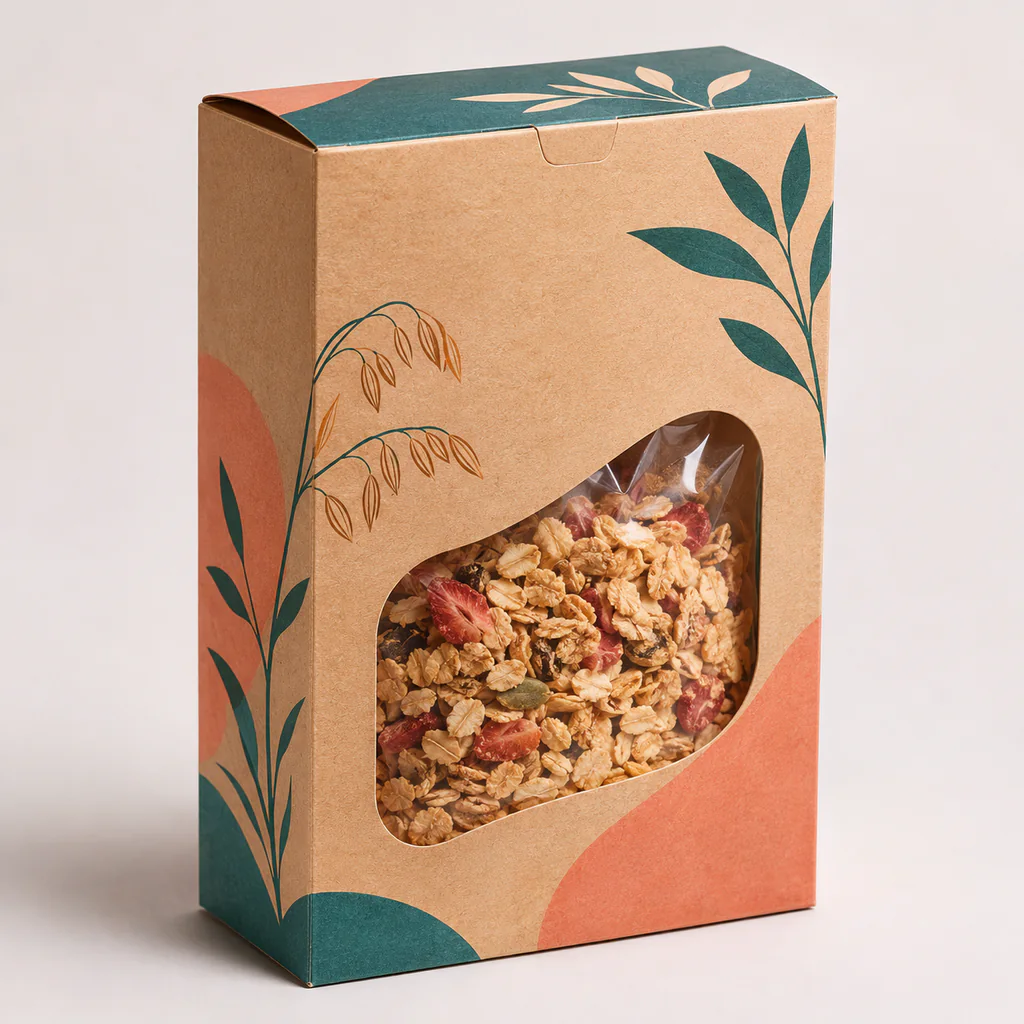
A custom cereal box is a tall printed paperboard carton, glued at both ends, that holds a sealed inner bag of cereal, granola or muesli. The carton carries the brand on the shelf while the bag keeps the food fresh.
From $0.72 per box
Price for 1 box at 7.5 × 2.5 × 11 in (191 × 64 × 279 mm), in Food-grade SBS 350–400 gsm, with full-color digital print on the outside.
| Quantity | Per box | Total |
|---|---|---|
| 1 | $0.72 | $0.72 |
| 100 | $0.72 | $72.00 |
| 250 | $0.72 | $180.00 |
| 500 | $0.72 | $360.00 |
| 1,000 | $0.72 | $720.00 |
| 2,500 | $0.72 | $1,800.00 |
| 5,000 | $0.72 | $3,600.00 |
The carton is a seal-end folding carton: both ends are glued shut on the filling line, which makes it strong enough for stacking and difficult to open by accident. The inner bag does the food-contact work, so the carton board can be recycled board.
Cereal boxes have large panels, so the front is a billboard on a crowded shelf. Back panels carry nutrition information, ingredients and promotional content.
Our custom cereal boxes are part of the food and beverage packaging range alongside our custom bakery boxes. Compare all 236 custom box types, or see how Custom Boxes makes printed packaging from one box.
Seal end · SE
The standard construction for custom cereal boxes is the seal end (SE). Both ends close with glued flaps, so the carton shows if it has been opened. It suits cereal, food and machine-filled products.
Both ends glued closed for filling lines.
A tuck flap for small-batch hand filling.
Single-serve sizes for hotels and variety packs.
| Box style | Seal end (SE) |
|---|---|
| Paperboard | SBS paperboard, 300–400 gsm (14–24 pt) |
| Print methods | Digital CMYK, Offset litho, Flexographic spot color |
| Finishes for this box | Food-safe inks, Full-color CMYK, Window patching, Grease-resistant coating, Matte or gloss varnish, Foil stamping |
| Minimum order | 1 box per size and artwork |
| Digital proof | Within 24 hours of receiving artwork |
| Production time | 8–12 business days after artwork approval |
| Shipping | Free standard shipping across the US, 3–6 business days, tracked |
| Returns | Free returns within 21 days of delivery |
The size buyers ask for most is 7.5 × 2.5 × 11 in (191 × 64 × 279 mm), used for standard 12 oz box. The smallest size listed here is 3 × 1.25 × 4 in (76 × 32 × 102 mm) (single-serve minis) and the largest is 9 × 2.75 × 12 in (229 × 70 × 305 mm) (family size). Every box is cut to your own inside dimensions, so treat these as starting points rather than fixed sizes.
| Inside size (L × W × D) | What fits |
|---|---|
| 7.5 × 2.5 × 11 in (191 × 64 × 279 mm) | Standard 12 oz box |
| 9 × 2.75 × 12 in (229 × 70 × 305 mm) | Family size |
| 6 × 2 × 9 in (152 × 51 × 229 mm) | Granola and muesli |
| 3 × 1.25 × 4 in (76 × 32 × 102 mm) | Single-serve minis |
Fill the actual bag to the intended amount and seal it as you will in production. Set it upright, let the cereal settle and measure the broadest part. The top seal can be wider than the bag near the middle. Use an inner liner unless you have confirmed the selected board is suitable for direct food contact. Fit the carton around the sealed inner bag, including the folds at both ends.
Try loading a sample at the speed your line normally runs. Check whether the bag catches as it passes the dust flaps. A carton with ample inside width can still have a narrow path while the flaps are held open. Watch the upper seal when the carton closes. It should lie in the planned space without making the top panel bow or the retail box lean forward.
A cereal carton spends time in the kitchen after the first opening. Give the top flap enough room to close again once the inner bag is folded down. Try it with a full bag and with a partly empty one. A folded bag may sit higher than expected. See whether the box can be set on a shelf without the lid lifting as the contents settle.
Put the opened sample beside a bowl and try pouring from it. The customer may hold the carton near its narrow side while keeping the bag in place. Make sure the opening leaves room for that grip without tearing a corner. If a tray holds small single servings, leave an opening through which the last bag can be reached without turning the entire carton over.
A large front can carry a simple product name while the narrow side identifies the variety on a packed shelf. Check both views with neighboring boxes in place. Keep a long line or a large block of text on an uninterrupted panel. We print the text exactly as supplied. Have it reviewed before sending artwork, including all text that differs by size or variety.
Use a full-size folded proof for the final review. Make sure any opening cue is near the tab it refers to and that the glue area does not cover the last part of a printed line. If a store adds a price label, put one in the intended spot. Check the box from the front, from the side and from above before approving a large run.
Measure the filled, sealed bag and add space to insert it.
Leave room for nutrition, ingredients and barcode.
Seal-end for machine filling, tuck tops for hand filling.
Unfamiliar terms on a quote? The packaging glossary explains them in plain English. No artwork yet? Our packaging design services team builds print-ready files on your dieline.
Pricing for custom cereal boxes starts at $0.72 per box for 1 box at 7.5 × 2.5 × 11 in (191 × 64 × 279 mm), in Food-grade SBS 350–400 gsm, with full-color digital print on the outside. The listed price is per box, in the standard specification, at any listed quantity. Larger runs, other boards and finishes are quoted.
After you send artwork, a digital proof comes back within 24 hours, and design help on the dieline is free. Production of custom cereal boxes takes 8–12 business days once the proof is approved. Standard shipping across the US is free and takes 3–6 business days, with tracking.
For production runs in the thousands, see wholesale custom boxes, compare every format on the custom box price list, or request a quote for custom cereal boxes.