Tuck end carton
The standard carton for blisters and bottles.
Health & Wellness
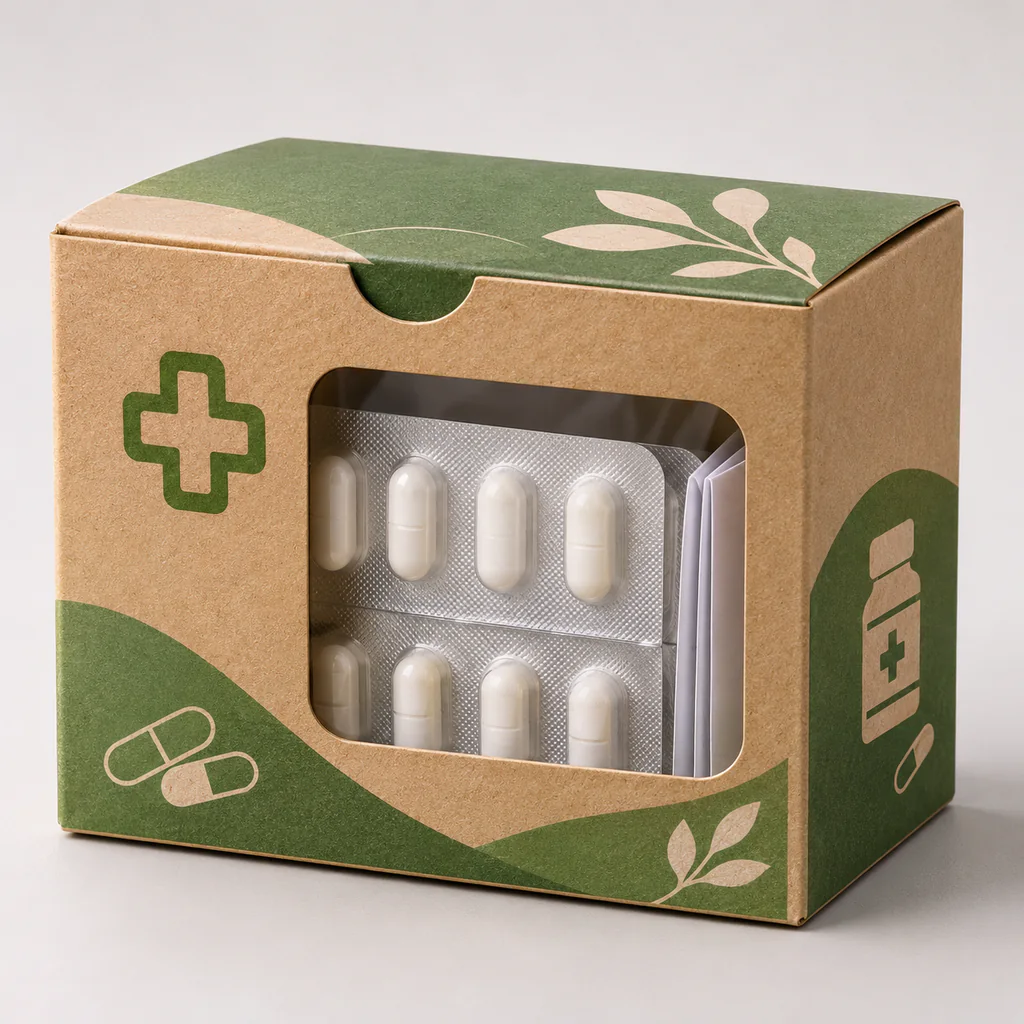
A custom pharmaceutical box is a folding carton for a medicine, over-the-counter product or medical device. It protects blisters, bottles and tubes, holds the patient leaflet, and carries the product name, dosage and coding required by regulators.
From $0.58 per box
Price for 1 box at 3.5 × 1 × 5 in (89 × 25 × 127 mm), in SBS paperboard 300–400 gsm, with full-color digital print on the outside.
| Quantity | Per box | Total |
|---|---|---|
| 1 | $0.58 | $0.58 |
| 100 | $0.58 | $58.00 |
| 250 | $0.58 | $145.00 |
| 500 | $0.58 | $290.00 |
| 1,000 | $0.58 | $580.00 |
| 2,500 | $0.58 | $1,450.00 |
| 5,000 | $0.58 | $2,900.00 |
Pharmaceutical cartons follow strict layouts set by each market's regulator, including product name, strength, batch and expiry, and often Braille and a unique identifier code. We print your approved artwork and can emboss Braille and leave clear zones for variable codes.
Most cartons are tuck end or crash-lock bottom boxes in SBS board, sized to hold the blister packs or bottle plus the folded patient leaflet.
Our custom pharmaceutical boxes are part of the retail and shelf packaging range alongside our custom product boxes. Compare all 236 custom box types, or see how Custom Boxes makes printed packaging from one box.
Reverse tuck end · RTE
The standard construction for custom pharmaceutical boxes is the reverse tuck end (RTE). Top and bottom tuck flaps close from opposite faces, so the carton prints and glues in one pass. It suits cosmetics, supplements and light retail products.
The standard carton for blisters and bottles.
An auto-lock bottom for heavier bottles.
Glued flaps or a tear strip that shows opening.
| Box style | Reverse tuck end (RTE) |
|---|---|
| Paperboard | SBS paperboard, 300–400 gsm (14–24 pt) |
| Print methods | Digital CMYK, Offset litho, Flexographic spot color |
| Finishes for this box | Full-color CMYK, Pantone spot colors, Matte or gloss lamination, Soft-touch lamination, Foil stamping, Embossing and debossing, Spot UV, Window patching |
| Minimum order | 1 box per size and artwork |
| Digital proof | Within 24 hours of receiving artwork |
| Production time | 8–12 business days after artwork approval |
| Shipping | Free standard shipping across the US, 3–6 business days, tracked |
| Returns | Free returns within 21 days of delivery |
The size buyers ask for most is 3.5 × 1 × 5 in (89 × 25 × 127 mm), used for blister packs with leaflet. The smallest size listed here is 2 × 2 × 4 in (51 × 51 × 102 mm) (small bottles) and the largest is 6 × 4 × 2 in (152 × 102 × 51 mm) (medical devices). Every box is cut to your own inside dimensions, so treat these as starting points rather than fixed sizes.
| Inside size (L × W × D) | What fits |
|---|---|
| 3.5 × 1 × 5 in (89 × 25 × 127 mm) | Blister packs with leaflet |
| 2 × 2 × 4 in (51 × 51 × 102 mm) | Small bottles |
| 2 × 1.25 × 6.5 in (51 × 32 × 165 mm) | Creams and tubes |
| 6 × 4 × 2 in (152 × 102 × 51 mm) | Medical devices |
Place the actual sealed blister stack or capped bottle beside the folded leaflet. A carton can have room for each part on its own and still be too tight where the folds overlap. Measure the leaflet with its final fold and check the broadest part of the inner pack. Load them together in the sequence the filling line uses and watch where the edges pass the dust flaps.
For blisters, stack a few in the intended direction and check whether peel tabs sit on top of one another. A tab that projects can catch when the stack is removed. Keep room near the opening so the recipient can take out the leaflet without tugging on a blister. For a bottle, set the leaflet where it will not press against the closure or disappear below the base support.
Set up a folded sample the way it will travel past any printing or labeling station. Mark which face the machine can reach and where a guide rail or belt meets the carton. A code can be readable on an empty box but hard to see if the full pack makes that face bow. Try the position with the product inside before approving the print layout.
Keep a sample at the bench for each size or version. Note the area reserved for the mark and the direction it is read after the pack closes. We print the text exactly as supplied. Have it reviewed before sending artwork, including the final size and orientation of the text and any parts left blank for details added later.
Open a closed sample and take the first item out without turning the carton over. Check whether the leaflet can come out on its own and whether a sealed blister remains clear of the flap. If the same box holds several pack counts, try the shortest stack and the tallest stack. A stop can limit movement without pressing on the sealed edge.
See how the carton behaves in the outer case or stock tray. Leave a flat face for the details staff need to read during picking. If the outer case is loaded end up, test that position with the leaflet and primary pack inside. Keep the approved sample with the packing instructions so later changes can be compared with the way the carton was tested.
We print your regulator-approved artwork exactly as supplied.
Keep blank areas for batch, expiry and serialization codes.
Allow for the folded patient leaflet as well as the product.
See what a box will cost to ship with the dimensional weight calculator. Unfamiliar terms on a quote? The packaging glossary explains them in plain English.
Pricing for custom pharmaceutical boxes starts at $0.58 per box for 1 box at 3.5 × 1 × 5 in (89 × 25 × 127 mm), in SBS paperboard 300–400 gsm, with full-color digital print on the outside. The listed price is per box, in the standard specification, at any listed quantity. Larger runs, other boards and finishes are quoted.
After you send artwork, a digital proof comes back within 24 hours, and design help on the dieline is free. Production of custom pharmaceutical boxes takes 8–12 business days once the proof is approved. Standard shipping across the US is free and takes 3–6 business days, with tracking.
For production runs in the thousands, see wholesale custom boxes, compare every format on the custom box price list, or request a quote for custom pharmaceutical boxes.