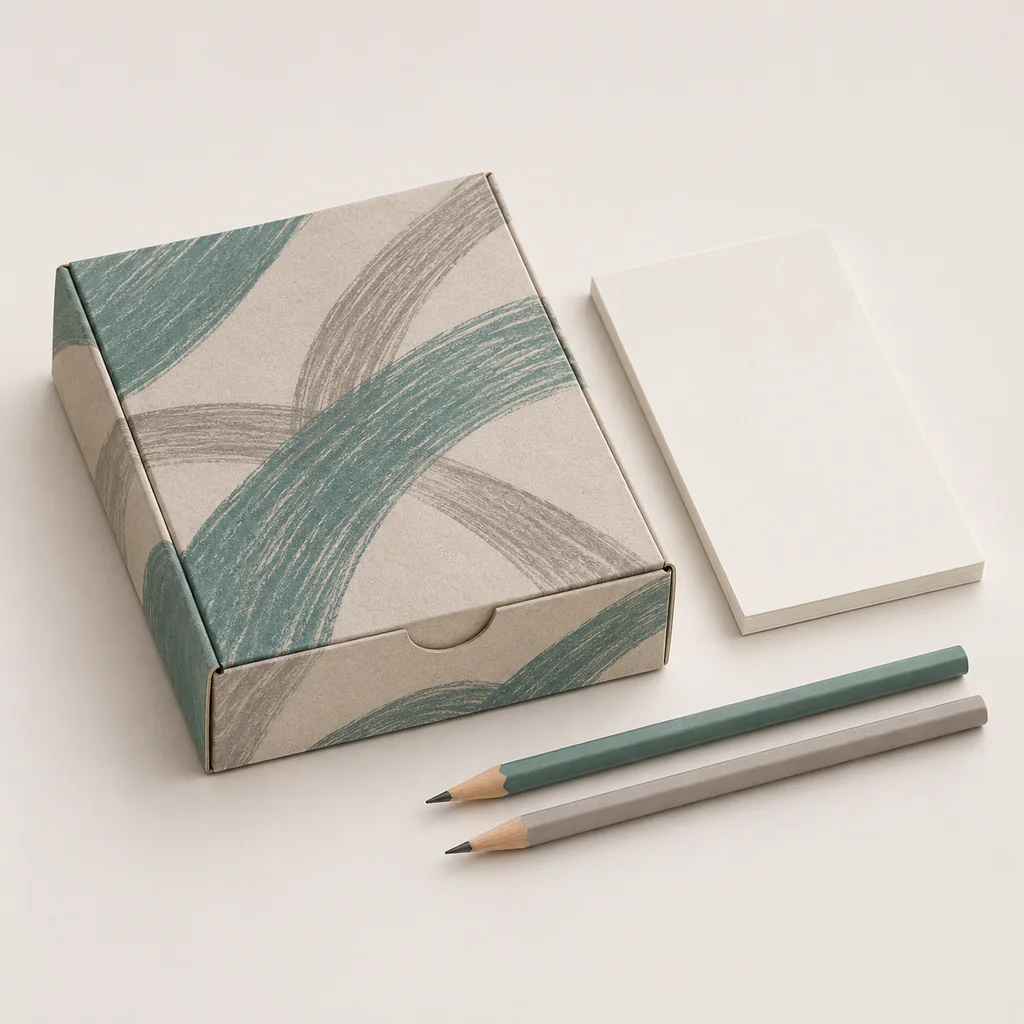
Shallow folding box with a fitted divider
Separate sharpened ends from paper and measure the tallest stack.
Retail Box Structures
A stationery box is made to fit pencils, notepads or small stationery sets. One construction option is a shallow folding box with a fitted divider.
From $0.79 per box
Price for 1 box at 7 × 4 × 1.5 in (178 × 102 × 38 mm), in Printed folding paperboard, with full-color digital print on the outside.
| Quantity | Per box | Total |
|---|---|---|
| 1 | $0.79 | $0.79 |
| 100 | $0.79 | $79.00 |
| 250 | $0.79 | $197.50 |
| 500 | $0.79 | $395.00 |
| 1,000 | $0.79 | $790.00 |
| 2,500 | $0.79 | $1,975.00 |
| 5,000 | $0.79 | $3,950.00 |
Custom printed boxes sized for pencils, notepads or small stationery sets.
Separate sharpened ends from paper and measure the tallest stack.
Stationery boxes hold sets: pencils and an eraser, a notepad and pens, or a gift of cards and envelopes. A shallow box with a fitted divider keeps each item in its place, so the set looks complete when opened and pencils do not mark the paper. Stationery buyers like a box that can be kept, so the lid often carries a pattern that works on a desk afterward. School and office suppliers tend to need simple, sturdy sets in volume, while gift shops and design brands focus on finishes such as foil or soft-touch on the lid.
Our custom stationery boxes are part of the retail and shelf packaging range alongside our custom product boxes. Compare all 236 custom box types, or see how Custom Boxes makes printed packaging from one box.
Reverse tuck end · RTE
The standard construction for custom stationery boxes is the reverse tuck end (RTE). Top and bottom tuck flaps close from opposite faces, so the carton prints and glues in one pass. It suits cosmetics, supplements and light retail products.
Separate sharpened ends from paper and measure the tallest stack.
| Box style | Reverse tuck end (RTE) |
|---|---|
| Print methods | Digital CMYK, Offset litho, Flexographic spot color |
| Finishes for this box | Full-color exterior print, Matte or gloss finish where compatible with the board and folds |
| Minimum order | 1 box per size and artwork |
| Digital proof | Within 24 hours of receiving artwork |
| Production time | 8–12 business days after artwork approval |
| Shipping | Free standard shipping across the US, 3–6 business days, tracked |
| Returns | Free returns within 21 days of delivery |
Every order is cut to your inside dimensions, so treat these sizes as starting points.
| Inside size (L × W × D) | What fits |
|---|---|
| 7 × 4 × 1.5 in (178 × 102 × 38 mm) | Starting point for pencils, notepads or small stationery sets. Confirm fit with a packed sample. |
| 5.5 × 3.25 × 1.25 in (140 × 83 × 32 mm) | Compact size: pencils, notepads or small stationery sets, travel or sample size |
| 8.75 × 5 × 2 in (222 × 127 × 51 mm) | Larger size: pencils, notepads or small stationery sets with an insert or extra room |
| 7 × 4 × 3 in (178 × 102 × 76 mm) | Double depth: pencils, notepads or small stationery sets, two layers deep |
Put the full set on a table before deciding on a tray shape. A pad can be highest at its glued edge, while a pen or ruler needs a longer run of clear space. Measure both at once and check that a divider does not press into the paper.
If a pen clip sticks out, give it an open area around the tip. Try the sample with the longest pencil and the deepest notepad together. A tray that looks neat from above can still let a piece slip under a paper stack when the box is turned.
Open the filled sample on a small work surface. Decide whether a recipient should lift the whole tray or reach the parts one by one. A short opening at the end of a notebook pocket can make the first item easy to take out. Keep any printed tab away from sharpened tips.
If the box will be kept on the desk, check whether it closes with the items replaced in a different order. A small label inside the tray can help people see where a ruler or eraser goes. Leave a little space for a notepad to come out by its binding.
Put a clear name on the short face for shop stock and on the lid for a gift version. Test a folded proof next to the actual paper and pens. If an event changes only the note in the pack, leave it in its own space so the outside can stay the same.
Check the box in the parcel it will travel in. A thin side wall may be hard to grip if the outer carton fits flush. Leave room to reach the base without pulling on the lid. Try the finished sample with all paper bands and labels in place.
Separate sharpened ends from paper and measure the tallest stack.
Turn a packed sample on its edge and check that pencils and notepads stay in their own sections.
Tilt the packed carton and check that narrow pieces cannot slide under the divider.
Want to feel the board and finishes first? Order a free sample pack before you commit. Still deciding? The custom box FAQ answers the questions buyers ask most before ordering.
Pricing for custom stationery boxes starts at $0.79 per box for 1 box at 7 × 4 × 1.5 in (178 × 102 × 38 mm), in Printed folding paperboard, with full-color digital print on the outside. The listed price is per box, in the standard specification, at any listed quantity. Larger runs, other boards and finishes are quoted.
After you send artwork, a digital proof comes back within 24 hours, and design help on the dieline is free. Production of custom stationery boxes takes 8–12 business days once the proof is approved. Standard shipping across the US is free and takes 3–6 business days, with tracking.
For production runs in the thousands, see wholesale custom boxes, compare every format on the custom box price list, or request a quote for custom stationery boxes.