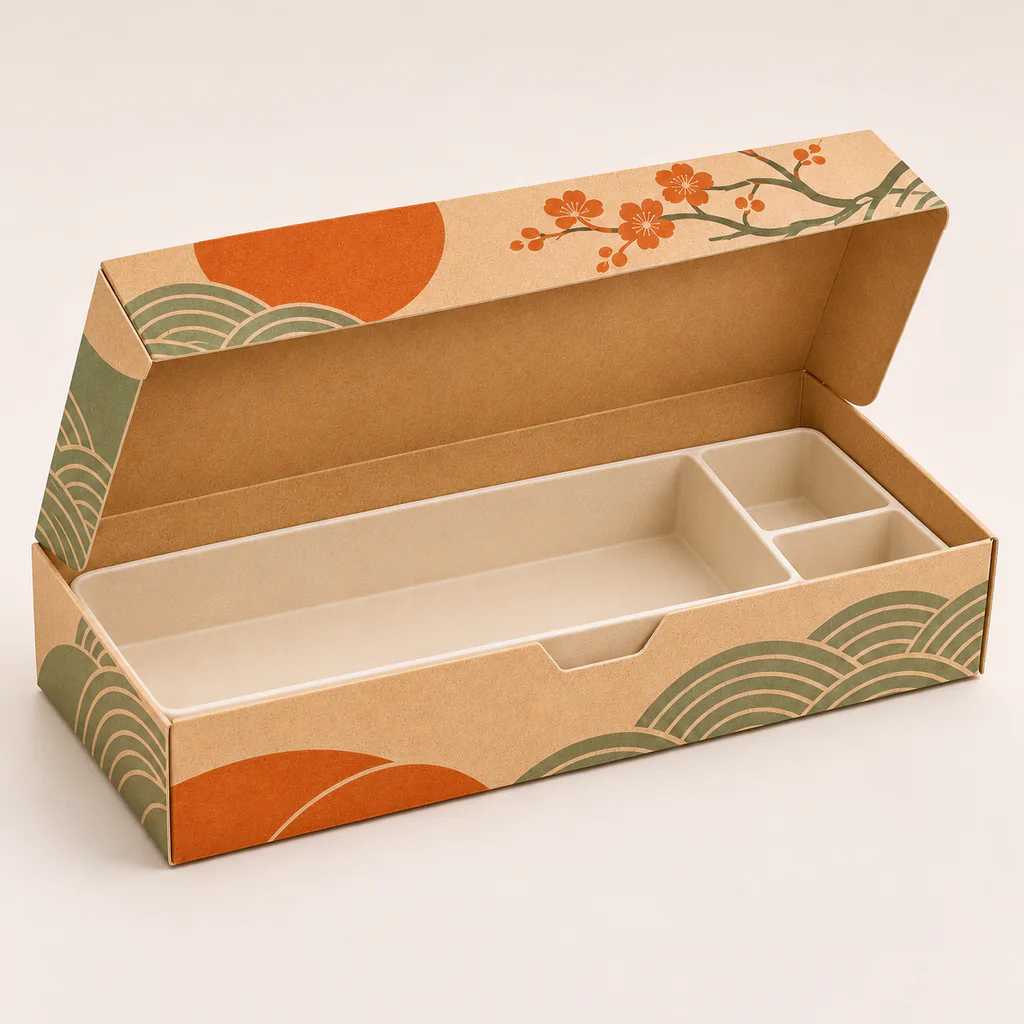
Shallow lidded carton
Reserve headroom for taller pieces and garnishes.
Food and Takeaway Packaging
A sushi box is a shallow food carton designed to keep rolls or pieces in rows during display and takeaway. A suitable liner, insert or tray supports the food and separates any sauces.
From $0.79 per box
Price for 1 box at 7 × 4 × 1.75 in (178 × 102 × 44 mm), in Food-contact folding board, with full-color digital print on the outside.
| Quantity | Per box | Total |
|---|---|---|
| 1 | $0.79 | $0.79 |
| 100 | $0.79 | $79.00 |
| 250 | $0.79 | $197.50 |
| 500 | $0.79 | $395.00 |
| 1,000 | $0.79 | $790.00 |
| 2,500 | $0.79 | $1,975.00 |
| 5,000 | $0.79 | $3,950.00 |
Shallow cartons for sushi rolls and mixed portions, with planned clearance for toppings and dips.
Sushi should sit level and have little room to slide. Condensation, moisture from rice and leaking sauces can weaken stock. Compare the closed pack at its expected chilled holding time, with sauce cups in their planned positions.
Our custom sushi boxes are part of the food and beverage packaging range alongside our custom bakery boxes. Compare all 236 custom box types, or see how Custom Boxes makes printed packaging from one box.
Reverse tuck end · RTE
The standard construction for custom sushi boxes is the reverse tuck end (RTE). Top and bottom tuck flaps close from opposite faces, so the carton prints and glues in one pass. It suits cosmetics, supplements and light retail products.
Reserve headroom for taller pieces and garnishes.
Show the assortment while keeping the sauce cup upright.
| Box style | Reverse tuck end (RTE) |
|---|---|
| Print methods | Digital CMYK, Offset litho, Flexographic spot color |
| Finishes for this box | Exterior brand print, Window where suitable, Moisture barrier to specification |
| Minimum order | 1 box per size and artwork |
| Digital proof | Within 24 hours of receiving artwork |
| Production time | 8–12 business days after artwork approval |
| Shipping | Free standard shipping across the US, 3–6 business days, tracked |
| Returns | Free returns within 21 days of delivery |
The size buyers ask for most is 7 × 4 × 1.75 in (178 × 102 × 44 mm), used for one compact row of rolls. The smallest size listed here is 7 × 4 × 1.75 in (178 × 102 × 44 mm) (one compact row of rolls) and the largest is 9 × 6 × 2 in (229 × 152 × 51 mm) (A mixed portion and a sealed sauce cup). Every box is cut to your own inside dimensions, so treat these as starting points rather than fixed sizes.
| Inside size (L × W × D) | What fits |
|---|---|
| 7 × 4 × 1.75 in (178 × 102 × 44 mm) | One compact row of rolls |
| 9 × 6 × 2 in (229 × 152 × 51 mm) | A mixed portion and a sealed sauce cup |
| 5.5 × 3.25 × 1.5 in (140 × 83 × 38 mm) | Compact size: one compact row of rolls, travel or sample size |
| 8.75 × 5 × 2.25 in (222 × 127 × 57 mm) | Larger size: one compact row of rolls with an insert or extra room |
Put the rolls and taller pieces into the actual liner or tray in the order the customer will see them. A garnish may fit beneath the closed lid and still be hit as the lid opens or closes. Check the clearance at the hinge and the front tuck. Use an inner liner unless the selected board has been confirmed suitable for direct food contact, and include it before settling on the inside size.
Try lifting one piece from the center with chopsticks while the carton rests on a table. The edge should leave enough room for that movement without making a tight row spread apart in transit. A shallow tray can make access easier. Check that the tray does not slide across the base if you put the box into a carry bag with other orders.
Place a sealed sauce cup or packet in the intended position and fill the main tray. Check the top of the cup against the lid, then see whether it can be reached before the first roll is lifted. A paper pocket can hold a small packet away from wet parts of the tray. Add the actual chopstick sleeve to the sample if it will travel inside or across the top.
Test a smaller assortment in the same outer carton if you expect to share it across the menu. Look for room where a packet could shift into the food. A short stop can divide that area without making the tray hard to remove. Mark the orientation on the packing instructions if the sauce well and the taller food can only sit at one end.
Set the filled sample in the place it will wait for the customer. Look at what the window shows from their side of the counter and whether it stays clear after the usual hold. Leave a label area where a name can still be read if moisture collects near the window. We print the text exactly as supplied. Have it reviewed before sending artwork, including any labels applied after packing.
If the order is carried in a bag, lift the box out as the customer would. A narrow lip may be easier to grip if the artwork and seal leave the edge clear. Set the box down and open it without moving the tray. Check that any artwork inside the lid faces the reader, and that the main mark on the front still reads after the order label is added.
Include garnishes and compare the closed lid clearance.
Check moisture, visibility and how the base behaves after transport.
If products move inside the box, the packaging inserts guide compares card, corrugated, foam and pulp. Once your design is approved, custom box subscriptions keep the same boxes arriving on a schedule without re-proofing.
Pricing for custom sushi boxes starts at $0.79 per box for 1 box at 7 × 4 × 1.75 in (178 × 102 × 44 mm), in Food-contact folding board, with full-color digital print on the outside. The listed price is per box, in the standard specification, at any listed quantity. Larger runs, other boards and finishes are quoted.
After you send artwork, a digital proof comes back within 24 hours, and design help on the dieline is free. Production of custom sushi boxes takes 8–12 business days once the proof is approved. Standard shipping across the US is free and takes 3–6 business days, with tracking.
For production runs in the thousands, see wholesale custom boxes, compare every format on the custom box price list, or request a quote for custom sushi boxes.