Tuck end tea carton
A carton for 20–40 tea bags.
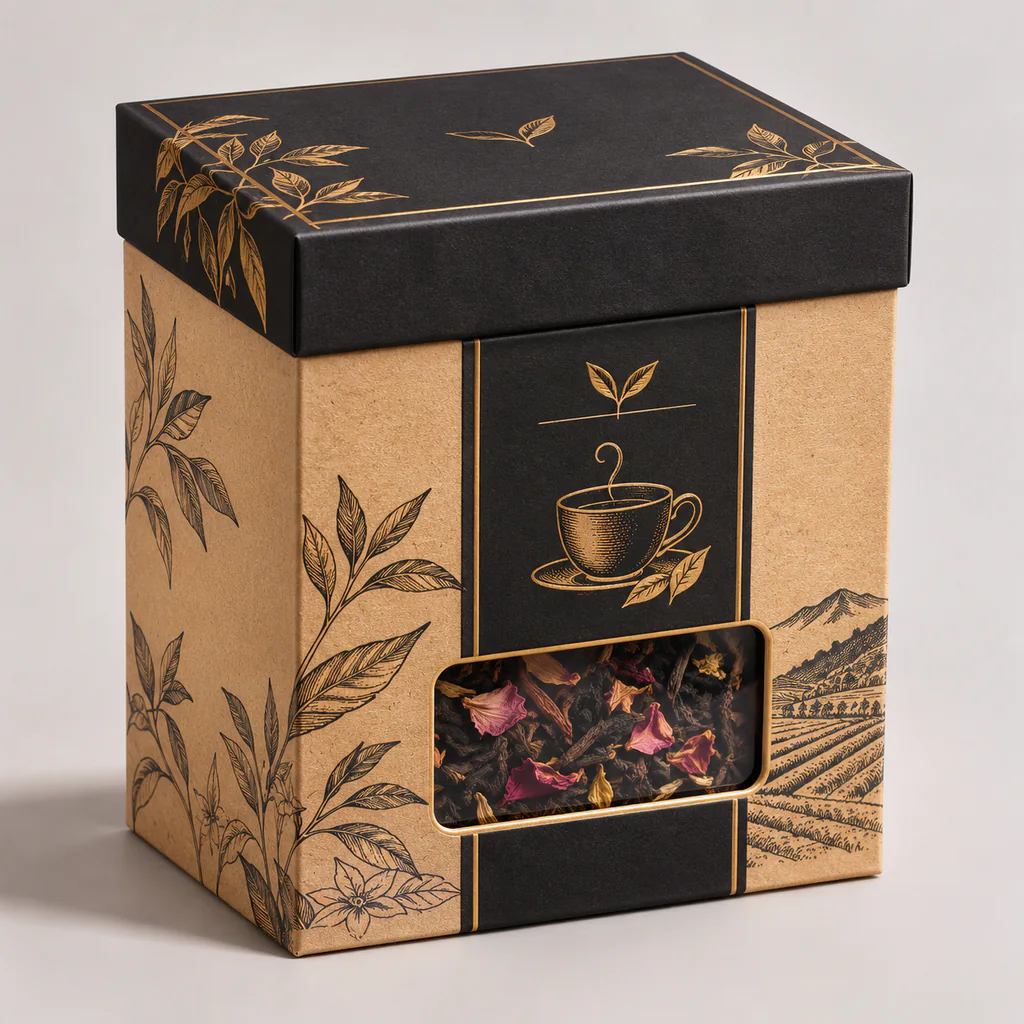
Food & Beverage
A custom tea box is a printed carton or tube that holds tea bags, sachets or a sealed pouch of loose-leaf tea. It protects the tea from light and crushing and presents the blend, origin and brewing guide.
From $0.71 per box
Price for 1 box at 5.5 × 3 × 2.75 in (140 × 76 × 70 mm), in Food-grade SBS 350–400 gsm, with full-color digital print on the outside.
| Quantity | Per box | Total |
|---|---|---|
| 1 | $0.71 | $0.71 |
| 100 | $0.71 | $71.00 |
| 250 | $0.71 | $177.50 |
| 500 | $0.71 | $355.00 |
| 1,000 | $0.71 | $710.00 |
| 2,500 | $0.71 | $1,775.00 |
| 5,000 | $0.71 | $3,550.00 |
Tea must be kept dry and away from light and strong smells, so loose tea goes into a sealed foil pouch inside the box, and tea bags usually sit in individual envelopes. The carton then protects the pack and tells the story of the blend.
Sampler and gift sets use compartment inserts or drawer boxes so customers can try several blends. Paper tubes are a popular premium alternative to tins.
Our custom tea boxes are part of the food and beverage packaging range alongside our custom bakery boxes. Compare all 236 custom box types, or see how Custom Boxes makes printed packaging from one box.
Reverse tuck end · RTE
The standard construction for custom tea boxes is the reverse tuck end (RTE). Top and bottom tuck flaps close from opposite faces, so the carton prints and glues in one pass. It suits cosmetics, supplements and light retail products.
A carton for 20–40 tea bags.
Compartments for several blends in one gift box.
A printed paper tube for loose-leaf pouches.
| Box style | Reverse tuck end (RTE) |
|---|---|
| Paperboard | SBS paperboard, 300–400 gsm (14–24 pt) |
| Print methods | Digital CMYK, Offset litho, Flexographic spot color |
| Finishes for this box | Food-safe inks, Full-color CMYK, Window patching, Grease-resistant coating, Matte or gloss varnish, Foil stamping |
| Minimum order | 1 box per size and artwork |
| Digital proof | Within 24 hours of receiving artwork |
| Production time | 8–12 business days after artwork approval |
| Shipping | Free standard shipping across the US, 3–6 business days, tracked |
| Returns | Free returns within 21 days of delivery |
The size buyers ask for most is 5.5 × 3 × 2.75 in (140 × 76 × 70 mm), used for 20 tea bags. The smallest size listed here is 5.5 × 3 × 2.75 in (140 × 76 × 70 mm) (20 tea bags) and the largest is 8 × 6 × 2.5 in (203 × 152 × 64 mm) (sampler sets). Every box is cut to your own inside dimensions, so treat these as starting points rather than fixed sizes.
| Inside size (L × W × D) | What fits |
|---|---|
| 5.5 × 3 × 2.75 in (140 × 76 × 70 mm) | 20 tea bags |
| 6 × 3.5 × 3.5 in (152 × 89 × 89 mm) | 40 tea bags |
| 8 × 6 × 2.5 in (203 × 152 × 64 mm) | Sampler sets |
| 3 in dia x 6 in | Loose-leaf tubes |
Arrange the finished envelopes the way you want the buyer to see them. A stack with seals at both ends can fan out at the top, even if the envelopes lie flat when empty. Try the actual count in a sample and check how the final packet can be reached. Use an inner liner unless the selected board has been confirmed suitable for direct food contact.
Loose tea in a sealed pouch calls for a different fit. Check the gusset at the base and the space needed when the top is folded over. If the carton is supposed to stand upright, try it once the pouch has settled. The carton should not need the pouch to prop up one side. Keep the opening large enough to let the customer take the pouch out without pulling on its seal.
Sort the blends before choosing the tray layout. If the customer should start with one blend, put it nearest the opening or mark a clear starting point on the flavor key. Give each packet enough room to come out without shifting its neighbors. Test the tray when a compartment is partly empty so the last envelope does not slide under a divider.
If you use a drawer, open the sample with a light pull and check when the far row becomes visible. A long tray may need to rest on the table before it comes fully out. Put a card where the customer can lift it without tilting the drawer. Try closing it after the first few envelopes are removed to see whether the card stays in place.
Place the filled carton in the same row as two or three related blends. Check whether the names are visible from the front and the end. A product color can help sort the range, but a readable name matters when two colors look similar. We print the text exactly as supplied. Have it reviewed before sending artwork, including any wording on a blend key or inside card.
Fold the artwork and look at the joint near the opening. An accent color or illustration can run into the fold if it was positioned from the flat design alone. If you plan to use a sticker for small runs, try it on the actual finish and keep it clear of the edge customers lift. Record which panel faces forward for each format in the range.
Decide on bags, envelopes or a pouch first, then size the box.
Tea absorbs odours, so we use low-odour inks and coatings.
Keep one box size and change colors per blend to save on tooling.
Agencies and resellers can order the same boxes under their own name with white-label packaging. Not sure of the size? The box size finder suggests the smallest box that fits your product.
Pricing for custom tea boxes starts at $0.71 per box for 1 box at 5.5 × 3 × 2.75 in (140 × 76 × 70 mm), in Food-grade SBS 350–400 gsm, with full-color digital print on the outside. The listed price is per box, in the standard specification, at any listed quantity. Larger runs, other boards and finishes are quoted.
After you send artwork, a digital proof comes back within 24 hours, and design help on the dieline is free. Production of custom tea boxes takes 8–12 business days once the proof is approved. Standard shipping across the US is free and takes 3–6 business days, with tracking.
For production runs in the thousands, see wholesale custom boxes, compare every format on the custom box price list, or request a quote for custom tea boxes.