Reverse tuck end carton
Tuck flaps at opposite ends; the standard carton for bottles, tubes and droppers.
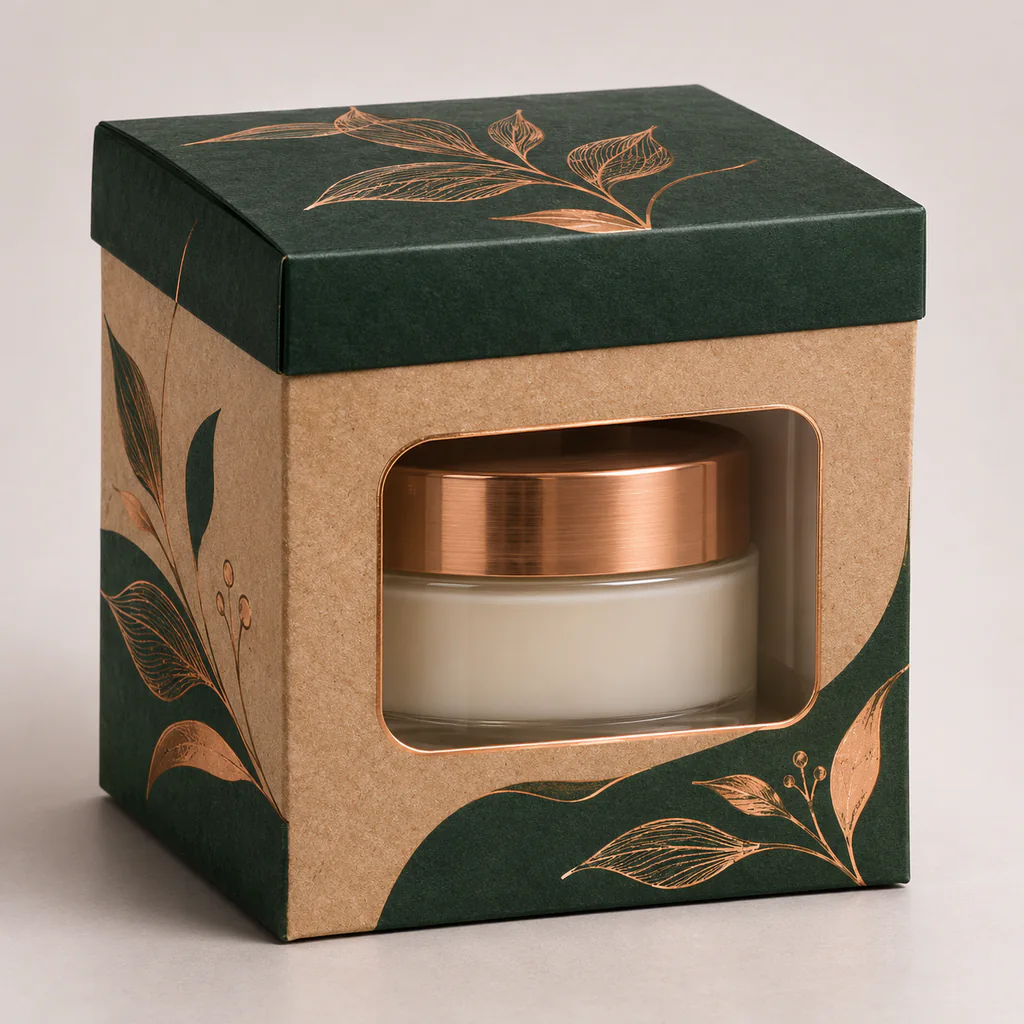
Beauty & Lifestyle
A custom cosmetic box is a printed paperboard carton made to hold a beauty product such as a serum bottle, cream jar, palette or tube. It protects the product, carries the ingredient and regulatory text, and sells the brand on a shelf or in an unboxing.
From $0.74 per box
Price for 1 box at 1.5 × 1.5 × 4.5 in (38 × 38 × 114 mm), in SBS paperboard 300–400 gsm, with full-color digital print on the outside.
| Quantity | Per box | Total |
|---|---|---|
| 1 | $0.74 | $0.74 |
| 100 | $0.74 | $74.00 |
| 250 | $0.74 | $185.00 |
| 500 | $0.74 | $370.00 |
| 1,000 | $0.74 | $740.00 |
| 2,500 | $0.74 | $1,850.00 |
| 5,000 | $0.74 | $3,700.00 |
Most cosmetic boxes are folding cartons in 300–400 gsm SBS board, because white board prints skin tones, pastels and fine type cleanly. A reverse tuck end suits bottles and tubes, a tuck top with an auto-lock bottom suits heavier jars, and a sleeve over a tray suits palettes and kits.
The box also has to carry information: the ingredient list, batch and expiry, net contents, the responsible person's address and recycling marks. Plan that text into the back panel from the start, at a size that stays legible after folding.
Finishes do most of the premium work. Soft-touch lamination, a single foil logo and an embossed brand mark make a carton feel expensive at a fraction of the cost of a rigid box.
Board weight follows the product. A light dropper bottle or lip tube sits well in 300 gsm board, which folds crisply at small sizes. A glass jar or a carton taller than about 6 in (152 mm) needs 350–400 gsm so the panels stay flat and the corners stay square when the box is picked up from a shelf.
Color is the part of a cosmetic box customers judge first, and it is also the hardest to match. Shade names, skin tones and brand colors print differently on coated white board, kraft board and under lamination. Approve a printed proof on the actual board and finish before a full run, and compare it with the product under the same light.
A range of products usually shares one carton family: the same style, board and finish in several sizes, with the artwork changed per product. Planning the family at the start keeps a shelf of serums, creams and cleansers looking consistent and lets several sizes be printed in one production run.
Our custom cosmetic boxes are part of the beauty, lifestyle and apparel packaging range alongside our custom product boxes. Compare all 236 custom box types, or see how Custom Boxes makes printed packaging from one box.
Reverse tuck end · RTE
The standard construction for custom cosmetic boxes is the reverse tuck end (RTE). Top and bottom tuck flaps close from opposite faces, so the carton prints and glues in one pass. It suits cosmetics, supplements and light retail products.
Tuck flaps at opposite ends; the standard carton for bottles, tubes and droppers.
A bottom that locks when the carton is opened, for heavier jars and glass.
A printed sleeve sliding over an inner tray, for palettes and gift kits.
| Box style | Reverse tuck end (RTE) |
|---|---|
| Paperboard | SBS paperboard, 300–400 gsm (14–24 pt) |
| Print methods | Digital CMYK, Offset litho, Flexographic spot color |
| Finishes for this box | Full-color CMYK, Pantone spot colors, Matte or gloss lamination, Soft-touch lamination, Foil stamping, Embossing and debossing, Spot UV, Window patching |
| Minimum order | 1 box per size and artwork |
| Digital proof | Within 24 hours of receiving artwork |
| Production time | 8–12 business days after artwork approval |
| Shipping | Free standard shipping across the US, 3–6 business days, tracked |
| Returns | Free returns within 21 days of delivery |
The size buyers ask for most is 1.5 × 1.5 × 4.5 in (38 × 38 × 114 mm), used for serum and dropper bottles. The smallest size listed here is 1.25 × 1.25 × 6 in (32 × 32 × 152 mm) (mascara, lip gloss and tubes) and the largest is 6 × 4 × 1.25 in (152 × 102 × 32 mm) (eyeshadow palettes). Every box is cut to your own inside dimensions, so treat these as starting points rather than fixed sizes.
| Inside size (L × W × D) | What fits |
|---|---|
| 1.5 × 1.5 × 4.5 in (38 × 38 × 114 mm) | Serum and dropper bottles |
| 2.5 × 2.5 × 2.5 in (64 × 64 × 64 mm) | Cream and moisturizer jars |
| 1.25 × 1.25 × 6 in (32 × 32 × 152 mm) | Mascara, lip gloss and tubes |
| 6 × 4 × 1.25 in (152 × 102 × 32 mm) | Eyeshadow palettes |
Cosmetics come in droppers, pumps, tubes, jars, compacts and palettes, and each needs a slightly different carton. Tall bottles and droppers sit in a slim tuck end carton with a card insert that holds the neck, so the glass cannot tip. Jars sit better in a squarer carton with a locking bottom. Tubes can go in a carton or a sleeve. Palettes and compacts suit a shallow tray with a sleeve, which keeps the face of the product flat.
Measure the container with its cap or pump on, at its widest point, and allow for any collar or shoulder. If several products share a carton size, set the insert for each one so the carton looks full and nothing rattles.
Cosmetic brands rarely sell one product, so the carton is designed as a family. A shared layout, with the logo, product name and key benefit in the same place on every carton, lets shoppers recognize the brand from across a shelf. Color can separate product types, such as cleansers, serums and creams, while the type and finishes stay constant.
Digital printing has no plate cost per design, so a range of many shades or formulas can each have its own carton in the same order. That makes it practical to launch a new shade or a limited edition in small numbers without changing the rest of the range.
Cosmetic cartons are handled by shoppers, testers and staff before they are sold, so the finish needs to wear well. Soft-touch lamination gives a velvet feel that suits skincare and premium makeup. Gloss lamination makes colors bright and is easy to wipe clean. Spot UV adds shine to a logo or pattern on a matte carton, and foil adds metallic detail.
Choose one or two finishes rather than many. A foil logo on a soft-touch carton reads as premium; adding spot UV, embossing and a second foil on the same small panel can make it look busy. A physical sample shows how the finish looks under store lighting.
Size the carton to the widest point of the bottle or jar, including caps and pumps, with about 1/16 in (1–2 mm) of clearance.
Place the ingredient list, batch and expiry before the design, so it is not squeezed in at the end.
One foil logo or one embossed mark looks more premium than several competing finishes.
Approve shade and brand colors on a printed proof in the chosen board and finish, not only on screen.
If products move inside the box, the packaging inserts guide compares card, corrugated, foam and pulp. Once your design is approved, custom box subscriptions keep the same boxes arriving on a schedule without re-proofing.
Pricing for custom cosmetic boxes starts at $0.74 per box for 1 box at 1.5 × 1.5 × 4.5 in (38 × 38 × 114 mm), in SBS paperboard 300–400 gsm, with full-color digital print on the outside. The listed price is per box, in the standard specification, at any listed quantity. Larger runs, other boards and finishes are quoted.
After you send artwork, a digital proof comes back within 24 hours, and design help on the dieline is free. Production of custom cosmetic boxes takes 8–12 business days once the proof is approved. Standard shipping across the US is free and takes 3–6 business days, with tracking.
For production runs in the thousands, see wholesale custom boxes, compare every format on the custom box price list, or request a quote for custom cosmetic boxes.