Straight tuck for wand tubes
Use a rectangular footprint and a closed-end stop.
Beauty and Bath Packaging
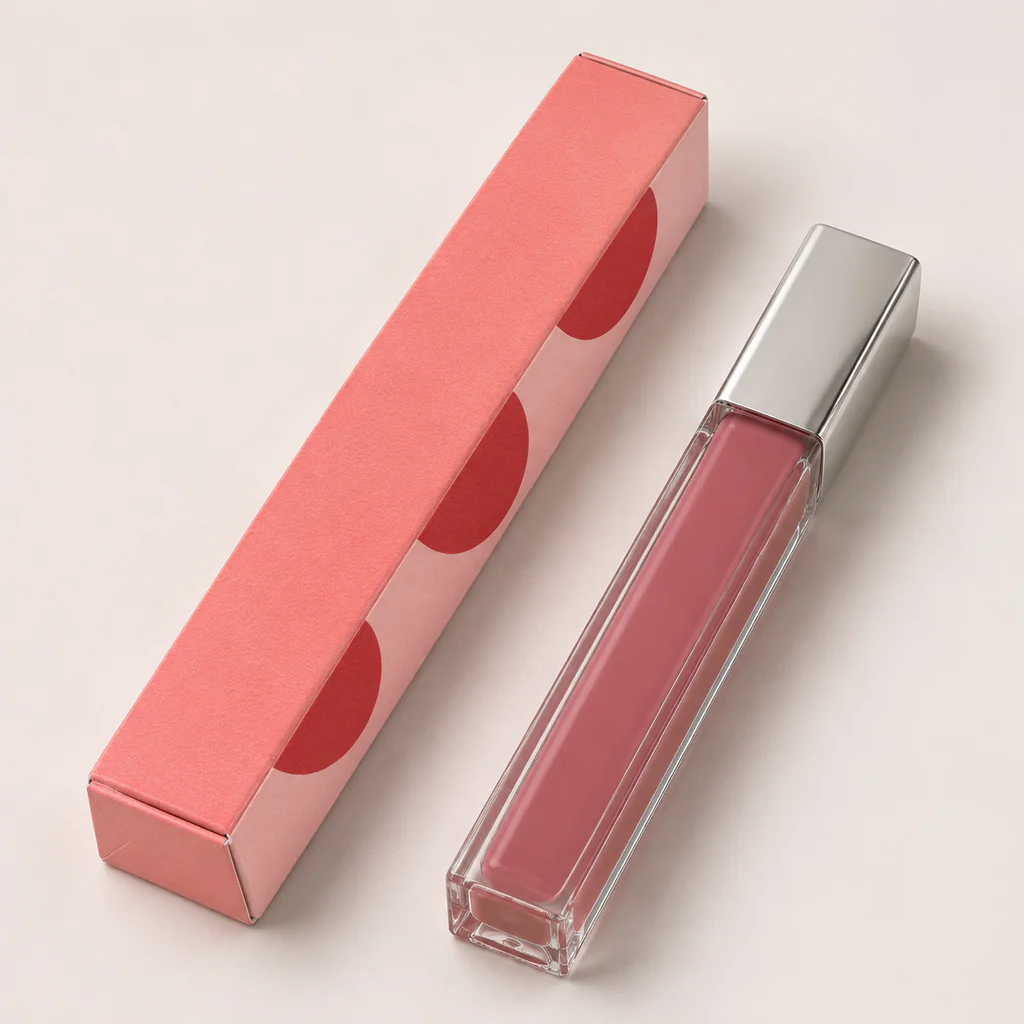
A lip gloss box is a slim retail carton sized around a closed wand tube or squeeze tube. The outer panels identify the formula and shade.
From $0.64 per box
Price for 1 box at 0.85 × 0.85 × 4.75 in (22 × 22 × 121 mm), in Bright SBS paperboard, with full-color digital print on the outside.
| Quantity | Per box | Total |
|---|---|---|
| 1 | $0.64 | $0.64 |
| 100 | $0.64 | $64.00 |
| 250 | $0.64 | $160.00 |
| 500 | $0.64 | $320.00 |
| 1,000 | $0.64 | $640.00 |
| 2,500 | $0.64 | $1,600.00 |
| 5,000 | $0.64 | $3,200.00 |
Printed cartons for long wand tubes and squeezable gloss packs with wider caps or crimped ends.
Wand caps and squeeze-tube crimps produce different shapes. The longest and widest points may occur at opposite ends. Use an end stop for a rounded tube that slides, and keep narrow sides clear of barcode fold lines.
Our custom lip gloss boxes are part of the beauty, lifestyle and apparel packaging range alongside our custom product boxes. Compare all 236 custom box types, or see how Custom Boxes makes printed packaging from one box.
Paper tube · TUBE
The standard construction for custom lip gloss boxes is the paper tube (TUBE). A wound paperboard cylinder with a lid and a base. It suits tea, cosmetics, apparel and posters.
Use a rectangular footprint and a closed-end stop.
Fit the sealed crimp without bending it.
| Box style | Paper tube (TUBE) |
|---|---|
| Paperboard | SBS paperboard, 300–400 gsm (14–24 pt) |
| Print methods | Digital CMYK, Offset litho, Flexographic spot color |
| Finishes for this box | Exterior full-color print, Matte or gloss varnish, Foil on a clear panel |
| Minimum order | 1 box per size and artwork |
| Digital proof | Within 24 hours of receiving artwork |
| Production time | 8–12 business days after artwork approval |
| Shipping | Free standard shipping across the US, 3–6 business days, tracked |
| Returns | Free returns within 21 days of delivery |
The size buyers ask for most is 0.85 × 0.85 × 4.75 in (22 × 22 × 121 mm), used for A narrow wand tube. The smallest size listed here is 0.85 × 0.85 × 4.75 in (22 × 22 × 121 mm) (A narrow wand tube) and the largest is 1.4 × 0.8 × 5.25 in (36 × 20 × 133 mm) (A squeeze tube with a wider sealed edge). Every box is cut to your own inside dimensions, so treat these as starting points rather than fixed sizes.
| Inside size (L × W × D) | What fits |
|---|---|
| 0.85 × 0.85 × 4.75 in (22 × 22 × 121 mm) | A narrow wand tube |
| 1.4 × 0.8 × 5.25 in (36 × 20 × 133 mm) | A squeeze tube with a wider sealed edge |
| 0.75 × 0.75 × 3.75 in (19 × 19 × 95 mm) | Compact size: A narrow wand tube, travel or sample size |
| 1 × 1 × 6 in (25 × 25 × 152 mm) | Larger size: A narrow wand tube with an insert or extra room |
Use the actual closed tube to try the loading motion. A long wand tube may go in cap first, while a soft squeeze tube can slide in more easily from the other end. Watch the tube near the dust flaps as it passes them. A crimp with wide corners can catch on an edge even when the widest part of the tube fits once it is inside.
If you pack gloss with an outer seal or a sleeve around the tube, use it in the trial. A rounded tube may need a folded stop to keep it from slipping under the main closure. Check that the end stop still leaves the customer enough of the cap to grip. Mark the fill end of the carton so staff can tell it from the end a shopper is meant to open.
Set two or three gloss shades next to each other as they will appear in a display. Look at the end panel from the customer's side of the counter. A color patch helps organize a range, but a readable shade name can distinguish two close colors under different lighting. Use a sample to see whether the cap or tube is visible through a window before relying on it to identify the shade.
The longest side of a narrow box can hold details that do not fit on the front. Read that side after closing the sample so you can see where the flap or join falls. A short line can end up partly under the fold if it is set too close. We print the text exactly as supplied. Have it reviewed before sending artwork, including the shade names for all versions.
For a set of several glosses, line the tubes up by cap width, not just by barrel width. Caps can touch even when the tube bodies have room to spare. Give each one a clear position and leave enough space for a finger to lift it out. A folded band can work when all tubes are the same length, while a tray can separate styles with different closures.
Set the first sample beside the individual gloss carton before finalizing the graphics. Check which face identifies the set and which identifies the shade. If the set includes a small card, see whether it fits beside the tray without pressing on a cap. Load every gloss, close the box, then open it from the customer side and check that the colors are shown in the intended order.
Check both ends and the maximum overall length.
Make sure packers can see the shade identifier at the expected end.
No artwork yet? Our packaging design services team builds print-ready files on your dieline. Agencies and resellers can order the same boxes under their own name with white-label packaging.
Pricing for custom lip gloss boxes starts at $0.64 per box for 1 box at 0.85 × 0.85 × 4.75 in (22 × 22 × 121 mm), in Bright SBS paperboard, with full-color digital print on the outside. The listed price is per box, in the standard specification, at any listed quantity. Larger runs, other boards and finishes are quoted.
After you send artwork, a digital proof comes back within 24 hours, and design help on the dieline is free. Production of custom lip gloss boxes takes 8–12 business days once the proof is approved. Standard shipping across the US is free and takes 3–6 business days, with tracking.
For production runs in the thousands, see wholesale custom boxes, compare every format on the custom box price list, or request a quote for custom lip gloss boxes.