Rectangular interfold carton
Set aperture and depth for a horizontal tissue stack.
Beauty and Bath Packaging
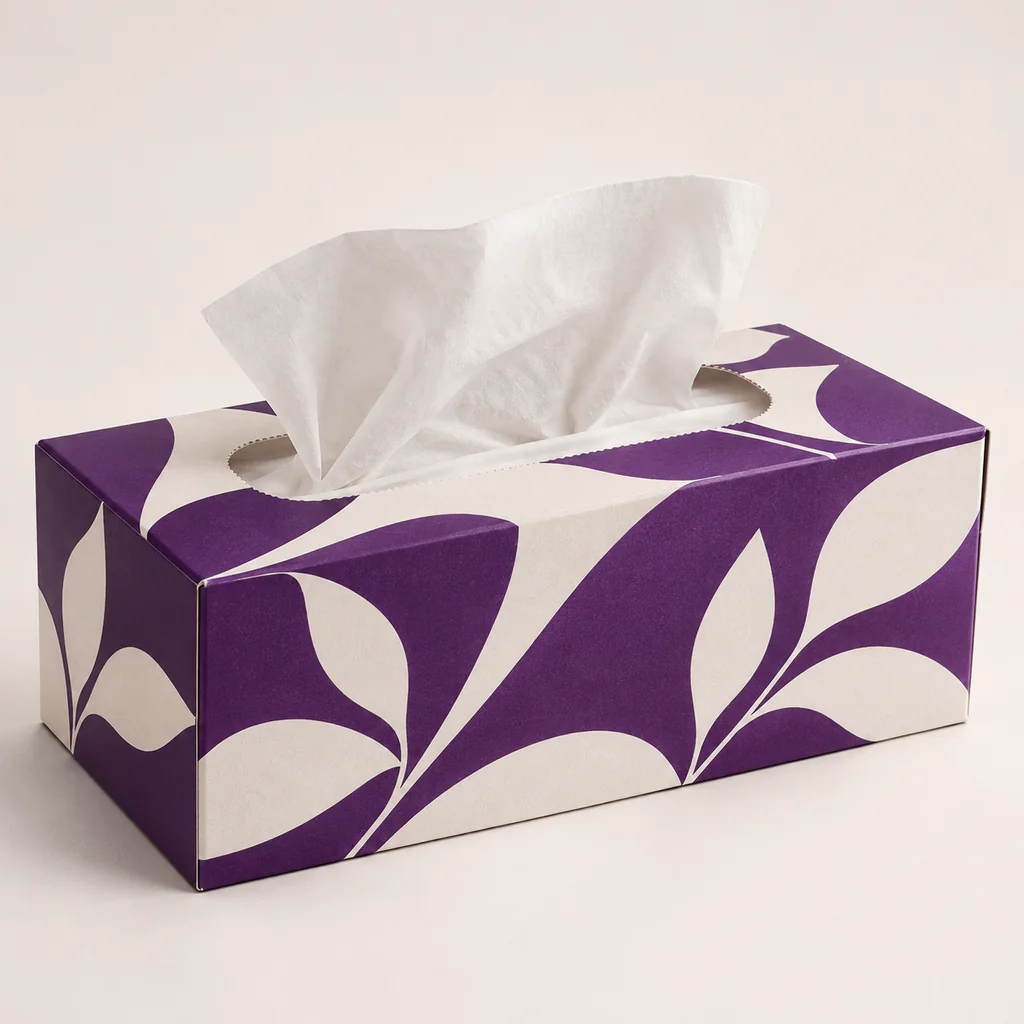
A tissue box is a printed folding carton with a dispensing opening sized to a stack of folded facial tissues. The box can use a perforated cover over the opening.
From $0.64 per box
Price for 1 box at 9 × 4.5 × 2.5 in (229 × 114 × 64 mm), in SBS paperboard, with full-color digital print on the outside.
| Quantity | Per box | Total |
|---|---|---|
| 1 | $0.64 | $0.64 |
| 100 | $0.64 | $64.00 |
| 250 | $0.64 | $160.00 |
| 500 | $0.64 | $320.00 |
| 1,000 | $0.64 | $640.00 |
| 2,500 | $0.64 | $1,600.00 |
| 5,000 | $0.64 | $3,200.00 |
Printed facial tissue cartons for hospitality, private label and retail multipacks. The specification covers the carton.
A narrow opening can tear the tissue or pull several sheets together. A wide opening exposes more of the pack and may let the next sheet drop back inside. Trial the cutout with the actual interfold and sheet count.
Our custom tissue boxes are part of the beauty, lifestyle and apparel packaging range alongside our custom product boxes. Compare all 236 custom box types, or see how Custom Boxes makes printed packaging from one box.
Reverse tuck end · RTE
The standard construction for custom tissue boxes is the reverse tuck end (RTE). Top and bottom tuck flaps close from opposite faces, so the carton prints and glues in one pass. It suits cosmetics, supplements and light retail products.
Set aperture and depth for a horizontal tissue stack.
Choose for a compact counter footprint and a vertical stack.
| Box style | Reverse tuck end (RTE) |
|---|---|
| Paperboard | SBS paperboard, 300–400 gsm (14–24 pt) |
| Print methods | Digital CMYK, Offset litho, Flexographic spot color |
| Finishes for this box | Exterior full-color print, Matte or gloss varnish, Foil on a clear panel |
| Minimum order | 1 box per size and artwork |
| Digital proof | Within 24 hours of receiving artwork |
| Production time | 8–12 business days after artwork approval |
| Shipping | Free standard shipping across the US, 3–6 business days, tracked |
| Returns | Free returns within 21 days of delivery |
The size buyers ask for most is 9 × 4.5 × 2.5 in (229 × 114 × 64 mm), used for A horizontal facial tissue stack. The smallest size listed here is 9 × 4.5 × 2.5 in (229 × 114 × 64 mm) (A horizontal facial tissue stack) and the largest is 4.5 × 4.5 × 5 in (114 × 114 × 127 mm) (A compact cube dispenser). Every box is cut to your own inside dimensions, so treat these as starting points rather than fixed sizes.
| Inside size (L × W × D) | What fits |
|---|---|
| 9 × 4.5 × 2.5 in (229 × 114 × 64 mm) | A horizontal facial tissue stack |
| 4.5 × 4.5 × 5 in (114 × 114 × 127 mm) | A compact cube dispenser |
| 7.25 × 3.5 × 2 in (184 × 89 × 51 mm) | Compact size: A horizontal facial tissue stack, travel or sample size |
| 11.25 × 5.75 × 3.25 in (286 × 146 × 83 mm) | Larger size: A horizontal facial tissue stack with an insert or extra room |
Set the full folded tissue stack into the sample with the first sheet in the intended position. Pull the first few sheets and see whether the next one stays near the opening. A long cut can leave too little support, while a short one can make soft sheets bunch. Try the same pulls once the carton is half full and again near the end.
If you use a film or paper opening insert, include it in the trial rather than checking the carton with an empty cutout. Watch how the material flexes as the tissue comes through. Make sure the edges do not catch a corner. Try the same stack in a tall cube and a low rectangular carton if both are possible.
Place the carton on a nightstand, desk or hotel shelf and remove the opening panel from that position. See whether the user can start the tear without moving the whole box. A panel that lifts smoothly should leave a clean rim. Keep the location easy to find even if the top carries a pattern.
If the carton fits inside a reusable cover, measure the finished outside edges and the position of the cutout. A close fit can hide part of the opening if the cover sits off center. Try putting in and taking out a full carton. Check that the customer can replace it without bending the corners or pulling against the cover.
Look at the box after the opening panel has been removed. A flower or border may be cut in half if the artwork was only checked flat. Put key parts of the design on the front and side, where they stay visible during use. For a retail multipack, check which box face appears through any outside band.
At a hotel, the short end of the carton may face a guest while the top sits beneath a shelf. Set up a folded sample in that position and check the placement of the name. If several counts share a design, keep a clear marker on the panel staff see when reaching for a replacement.
Check compression and sheet presentation at low fill.
The cover should lift without tearing the main panel.
Load the intended folded stack and set the first sheet under the opening as staff will. Try the pull with the box on a smooth surface. If the box moves or the next sheet drops, test the opening with the actual sheet fold and liner.
See what a box will cost to ship with the dimensional weight calculator. Unfamiliar terms on a quote? The packaging glossary explains them in plain English.
Pricing for custom tissue boxes starts at $0.64 per box for 1 box at 9 × 4.5 × 2.5 in (229 × 114 × 64 mm), in SBS paperboard, with full-color digital print on the outside. The listed price is per box, in the standard specification, at any listed quantity. Larger runs, other boards and finishes are quoted.
After you send artwork, a digital proof comes back within 24 hours, and design help on the dieline is free. Production of custom tissue boxes takes 8–12 business days once the proof is approved. Standard shipping across the US is free and takes 3–6 business days, with tracking.
For production runs in the thousands, see wholesale custom boxes, compare every format on the custom box price list, or request a quote for custom tissue boxes.