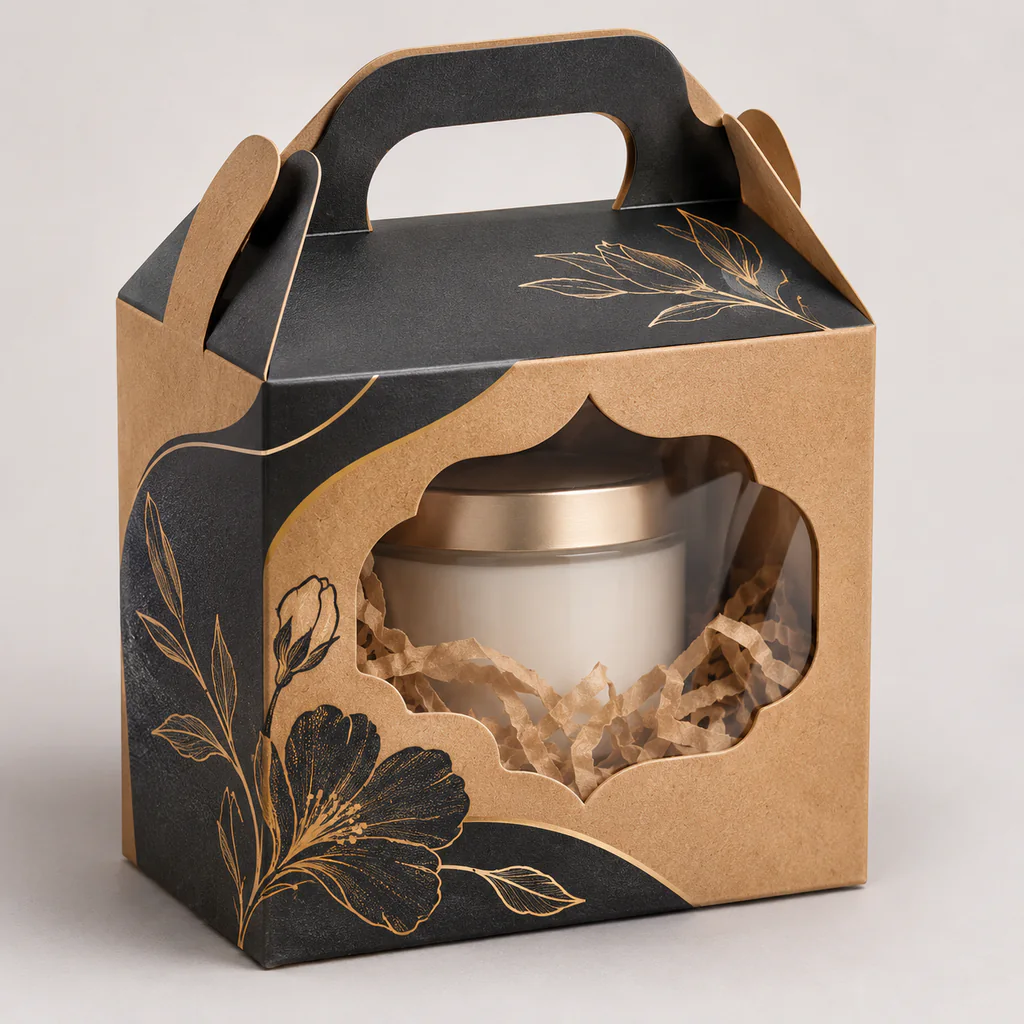
Shaped window box
A window cut to a logo or product outline.
Retail & Shelf
A custom die cut box is a box whose shape, flaps, windows and closures are cut by a steel-rule die made for your design. Any folding box is die-cut, but the term usually means a non-standard shape or feature designed for one product.
From $0.76 per box
Price for 1 box at Any size, in SBS paperboard 300–400 gsm, with full-color digital print on the outside.
| Quantity | Per box | Total |
|---|---|---|
| 1 | $0.76 | $0.76 |
| 100 | $0.76 | $76.00 |
| 250 | $0.76 | $190.00 |
| 500 | $0.76 | $380.00 |
| 1,000 | $0.76 | $760.00 |
| 2,500 | $0.76 | $1,900.00 |
| 5,000 | $0.76 | $3,800.00 |
A cutting die is a board fitted with steel blades and creasing rules in the exact outline of the flat box. It cuts and creases each sheet in one press, so shapes such as handles, shaped windows, locking tabs and curves cost the same per box as straight edges once the die exists.
Our structural designers draw the dieline around your product, make a plain sample to check the fit, and only then cut the production die.
Our custom die cut boxes are part of the beauty, lifestyle and apparel packaging range alongside our custom product boxes. Compare all 236 custom box types, or see how Custom Boxes makes printed packaging from one box. Also part of our retail packaging range.
Window carton · WIN
The standard construction for custom die cut boxes is the window carton (WIN). A carton with a die-cut opening covered by clear film. It suits bakery, toys and products sold on sight.
A window cut to a logo or product outline.
An integral handle for carrying.
A new shape designed around your product.
| Box style | Window carton (WIN) |
|---|---|
| Paperboard | SBS paperboard, 300–400 gsm (14–24 pt) |
| Print methods | Digital CMYK, Offset litho, Flexographic spot color |
| Finishes for this box | Full-color CMYK, Pantone spot colors, Matte or gloss lamination, Soft-touch lamination, Foil stamping, Embossing and debossing, Spot UV, Window patching |
| Minimum order | 1 box per size and artwork |
| Digital proof | Within 24 hours of receiving artwork |
| Production time | 8–12 business days after artwork approval |
| Shipping | Free standard shipping across the US, 3–6 business days, tracked |
| Returns | Free returns within 21 days of delivery |
Every order is cut to your inside dimensions, so treat these sizes as starting points.
| Inside size (L × W × D) | What fits |
|---|---|
| Any size | Designed to your product |
| Up to 28 × 40 in (711 × 1016 mm) sheet | Largest flat blank |
| From 1.5 in | Smallest practical dimension |
| Sample first | Plain structural sample before print |
A die-cut opening can show a product, give fingers a place to lift a tray or locate a box on a peg. Define that job before drawing the shape. If a window should show a label, fit the real product and check the view through a folded sample. If the cut is a grip, try it with the lid closed and with the item held at the point of use.
Leave room around the cut to support the panel. A long slot near a fold can make a wall move as someone opens it. Use an empty sample and then a loaded one to see where it bends. Try a shorter slot or a different position if the part around it needs to stay firm. Keep corners clear of any tuck that has to pass through the same space.
A blank can have the right outline while its tabs are awkward to put together. Fold a sample in the order staff will assemble it. Check whether a tab needs room to turn, or whether a lock sits too close to a window or printed edge. Tell us which movements the packer needs to make with one hand or while the product is already in the box.
If there is a shaped insert, test its fit after the outer walls are folded. A narrow opening can become tighter once the sides of the carton are locked. Look at where the insert comes out, not just how it goes in. Adjust the clearances before the cutting layout is fixed. Keep the approved blank and a folded sample together for future reference.
Use the final cutting outline to place artwork around windows, handles and slots. Give narrow lines room at the corners so a small change in a fold does not cut across the design. Check where the printed faces meet after closing the box. A visible border may need to move even if it looks even in the artwork file.
If more than one product shares the same structure, test the cut with the largest item and the smallest one. Check that the view, opening or grip still works for both. Fit any stock label to the actual box so it does not cover a cut or interfere with a tab. Use the same folded sample when checking the print again.
Send samples or a 3D file so the structure fits.
Check the fit before printing the full run.
A new die is a one-off cost, reused on every reorder.
Total an order with the packaging cost calculator, or compare formats on the custom box price list. If products move inside the box, the packaging inserts guide compares card, corrugated, foam and pulp.
Pricing for custom die cut boxes starts at $0.76 per box for 1 box at Any size, in SBS paperboard 300–400 gsm, with full-color digital print on the outside. The listed price is per box, in the standard specification, at any listed quantity. Larger runs, other boards and finishes are quoted.
After you send artwork, a digital proof comes back within 24 hours, and design help on the dieline is free. Production of custom die cut boxes takes 8–12 business days once the proof is approved. Standard shipping across the US is free and takes 3–6 business days, with tracking.
For production runs in the thousands, see wholesale custom boxes, compare every format on the custom box price list, or request a quote for custom die cut boxes.