Interlocking grid
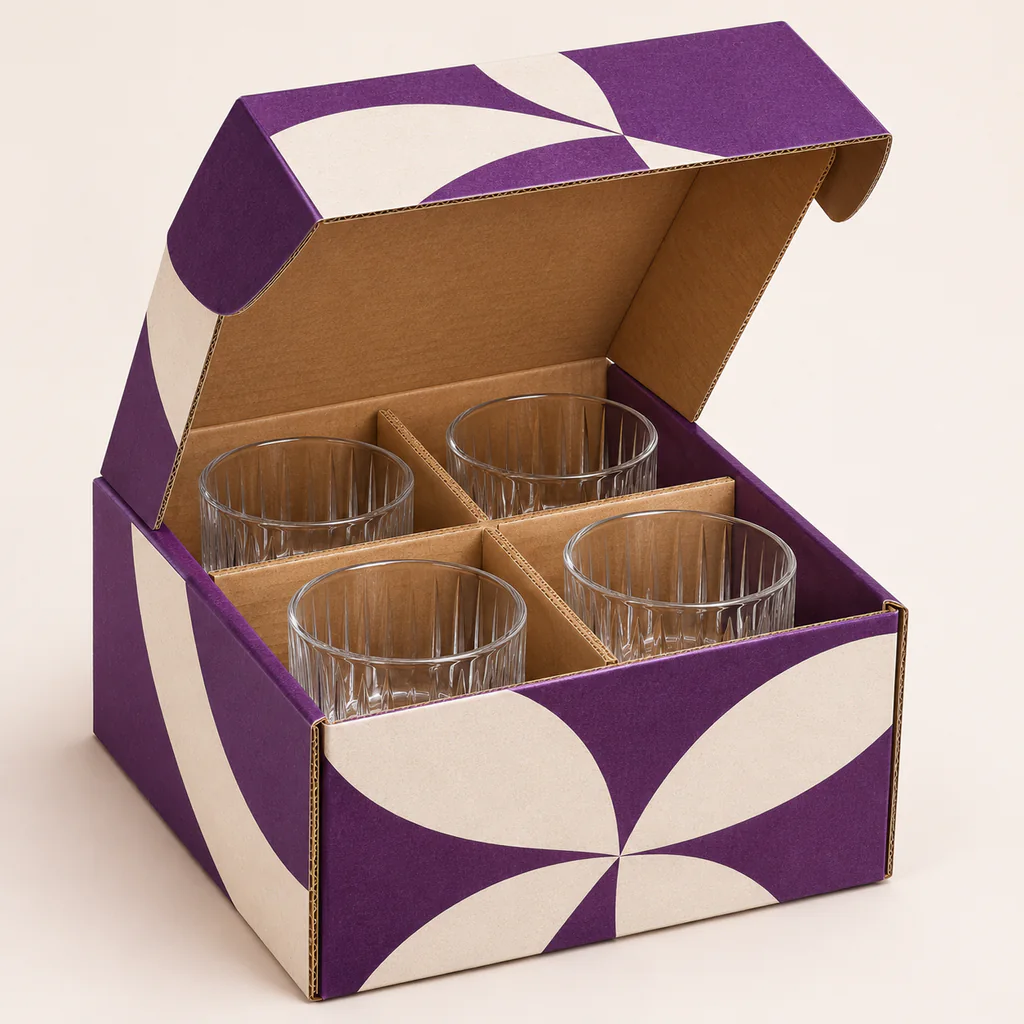
Size each corrugated cell for a tumbler or wrapped jar.
Shipping and Moving Boxes
A glassware box is a corrugated outer carton with partitions or fitted supports that stop glass pieces from touching each other and the outside walls.
From $1.49 per box
Price for 1 box at 10 × 8 × 6 in (254 × 203 × 152 mm), in Corrugated outer with corrugated dividers, with full-color digital print on the outside.
| Quantity | Per box | Total |
|---|---|---|
| 1 | $1.49 | $1.49 |
| 100 | $1.49 | $149.00 |
| 250 | $1.49 | $372.50 |
| 500 | $1.49 | $745.00 |
| 1,000 | $1.49 | $1,490.00 |
| 2,500 | $1.49 | $3,725.00 |
| 5,000 | $1.49 | $7,450.00 |
Partitioned boxes for drinking glasses, jars and stems, with clearance around rims, feet and handles.
A simple grid works for tumblers of similar height. Stemware needs support near the bowl and foot so the stem does not take the weight in a drop. Jars and handled mugs need different cell widths even when their body diameter looks similar.
Our custom glassware boxes are part of the shipping and ecommerce boxes range alongside our custom shipping boxes. Compare all 236 custom box types, or see how Custom Boxes makes printed packaging from one box.
Reverse tuck end · RTE
The standard construction for custom glassware boxes is the reverse tuck end (RTE). Top and bottom tuck flaps close from opposite faces, so the carton prints and glues in one pass. It suits cosmetics, supplements and light retail products.
Size each corrugated cell for a tumbler or wrapped jar.
Capture the bowl and base of a stemmed glass while leaving the stem free of load.
| Box style | Reverse tuck end (RTE) |
|---|---|
| Strength grades | 32 ECT single wall: 200 psi burst, up to 65 lb (29 kg); 44 ECT single wall: 275 psi burst, up to 95 lb (43 kg); 48 ECT double wall: 275 psi burst, up to 100 lb (45 kg) |
| Print methods | Digital CMYK, Offset litho, Flexographic spot color |
| Finishes for this box | Spot-color logo, Fragile handling marks, Printed pack-position labels |
| Minimum order | 1 box per size and artwork |
| Digital proof | Within 24 hours of receiving artwork |
| Production time | 8–12 business days after artwork approval |
| Shipping | Free standard shipping across the US, 3–6 business days, tracked |
| Returns | Free returns within 21 days of delivery |
The size buyers ask for most is 10 × 8 × 6 in (254 × 203 × 152 mm), used for four small tumblers in a grid. The smallest size listed here is 10 × 8 × 6 in (254 × 203 × 152 mm) (four small tumblers in a grid) and the largest is 16 × 12 × 10 in (406 × 305 × 254 mm) (stemware or mugs held in fitted cells). Every box is cut to your own inside dimensions, so treat these as starting points rather than fixed sizes.
| Inside size (L × W × D) | What fits |
|---|---|
| 10 × 8 × 6 in (254 × 203 × 152 mm) | Four small tumblers in a grid |
| 16 × 12 × 10 in (406 × 305 × 254 mm) | Stemware or mugs held in fitted cells |
| 8 × 6.5 × 4.75 in (203 × 165 × 121 mm) | Compact size: four small tumblers in a grid, travel or sample size |
| 12.5 × 10 × 7.5 in (318 × 254 × 191 mm) | Larger size: four small tumblers in a grid with an insert or extra room |
Arrange the wrapped glasses in their intended orientation. A handle can sit higher than the part of a mug that fits inside a cell. Measure around it with the wrap in place. Fit the cell with enough room to lower the glass without catching the handle or pushing the neighboring piece aside.
For stemware, note where the bowl and foot can take support and keep the stem free. Check the tallest and shortest glass if several shapes share a case. The top pad should clear the rim and sit in its own place when the case closes.
Put the full set in the box and see whether any divider lifts as the last glass goes in. A slot that is easy to assemble can leave a gap at the base. Try removing one piece and see whether the rest stay separated when the pack is moved.
If a case has more than one layer, fit the sheet between the layers before measuring total height. Check whether that sheet has a clear edge to lift without contacting the rims. The receiver should be able to open the box and remove the first row without pulling on a glass handle.
Use a photo of the loaded cells to show the fill direction. Mark which side of a divider faces a wide handle or a tall glass. Keep the case label on a face the receiver can see without turning the carton over.
Try the finished pack with the tape, outer carton and labels it will use. See whether staff can open it without cutting near a wrapped glass. Keep the exact glass shapes, wraps and divider layout together for any future order.
Use the largest outside measurement for each glass, including any wrap.
Sample the least stable orientation and inspect for chips after handling.
Lower the largest wrapped glass into the cell and check where the wrap meets the handle or rim. The wall should stay in position without forcing the glass against a neighboring cell. Leave room to get a hand around the part that is safe to lift.
Total an order with the packaging cost calculator, or compare formats on the custom box price list. If products move inside the box, the packaging inserts guide compares card, corrugated, foam and pulp.
Pricing for custom glassware boxes starts at $1.49 per box for 1 box at 10 × 8 × 6 in (254 × 203 × 152 mm), in Corrugated outer with corrugated dividers, with full-color digital print on the outside. The listed price is per box, in the standard specification, at any listed quantity. Larger runs, other boards and finishes are quoted.
After you send artwork, a digital proof comes back within 24 hours, and design help on the dieline is free. Production of custom glassware boxes takes 8–12 business days once the proof is approved. Standard shipping across the US is free and takes 3–6 business days, with tracking.
For production runs in the thousands, see wholesale custom boxes, compare every format on the custom box price list, or request a quote for custom glassware boxes.