Tuck box
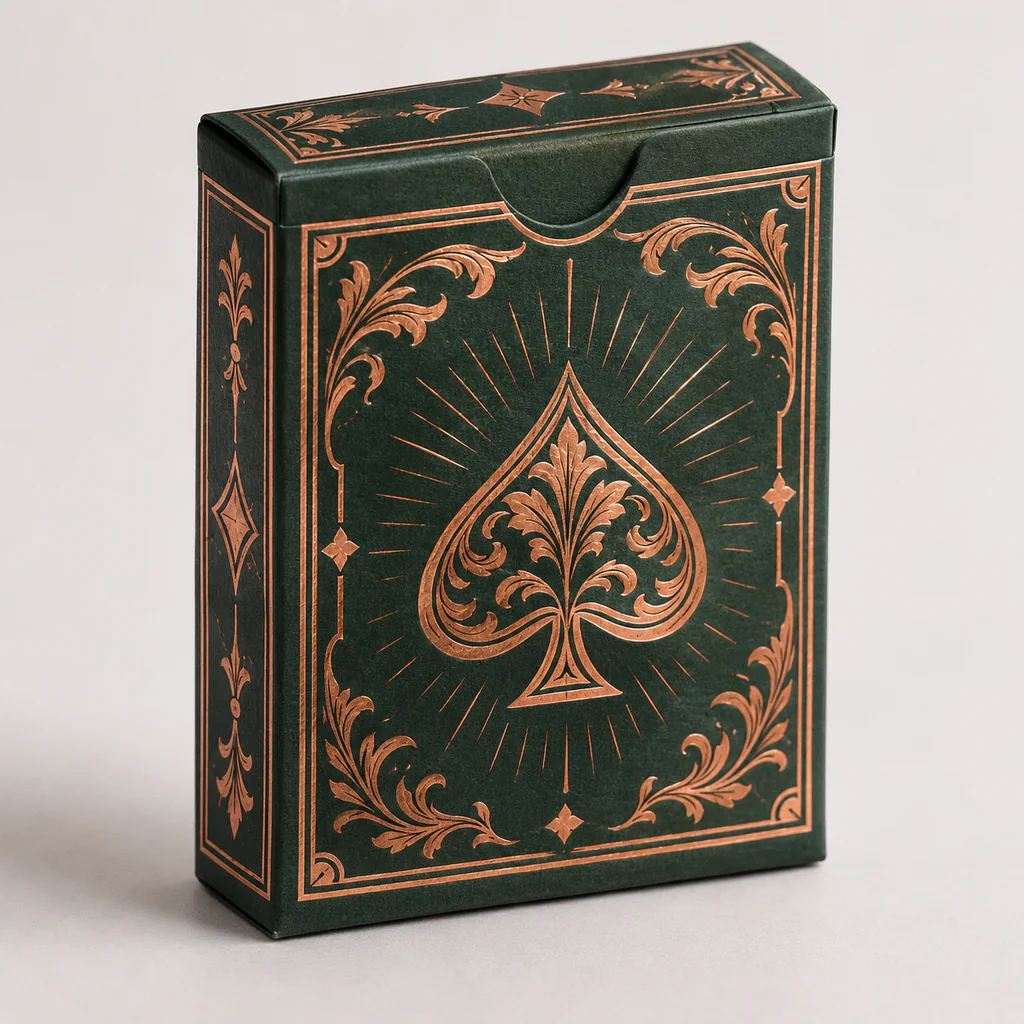
A tuck end carton for a single deck.
Tech & Games
A custom playing card box is a small tuck end carton sized to hold a deck of cards, such as playing cards, tarot or flash cards. It protects the deck, keeps it together and gives it a collectable cover.
From $0.45 per box
Price for 1 box at 2.5 × 3.5 × 0.75 in (64 × 89 × 19 mm), in SBS paperboard 300–400 gsm, with full-color digital print on the outside.
| Quantity | Per box | Total |
|---|---|---|
| 1 | $0.45 | $0.45 |
| 100 | $0.45 | $45.00 |
| 250 | $0.45 | $112.50 |
| 500 | $0.45 | $225.00 |
| 1,000 | $0.45 | $450.00 |
| 2,500 | $0.45 | $1,125.00 |
| 5,000 | $0.45 | $2,250.00 |
Card boxes, called tuck boxes, are sized to the deck's exact dimensions and thickness. A standard 54-card poker deck fits a box about 2.5 x 3.5 x 0.75 in; tarot and oracle decks are larger.
Decks are collected, so finishes such as foil, embossing and metallic inks are common. A seal sticker over the tuck flap shows the deck is new.
Our custom playing card boxes are part of the retail and shelf packaging range alongside our custom product boxes. Compare all 236 custom box types, or see how Custom Boxes makes printed packaging from one box.
Reverse tuck end · RTE
The standard construction for custom playing card boxes is the reverse tuck end (RTE). Top and bottom tuck flaps close from opposite faces, so the carton prints and glues in one pass. It suits cosmetics, supplements and light retail products.
A tuck end carton for a single deck.
A lid and base for premium or larger decks.
A hinged box for tarot and collector decks.
| Box style | Reverse tuck end (RTE) |
|---|---|
| Paperboard | SBS paperboard, 300–400 gsm (14–24 pt) |
| Print methods | Digital CMYK, Offset litho, Flexographic spot color |
| Finishes for this box | Full-color CMYK, Pantone spot colors, Matte or gloss lamination, Soft-touch lamination, Foil stamping, Embossing and debossing, Spot UV, Window patching |
| Minimum order | 1 box per size and artwork |
| Digital proof | Within 24 hours of receiving artwork |
| Production time | 8–12 business days after artwork approval |
| Shipping | Free standard shipping across the US, 3–6 business days, tracked |
| Returns | Free returns within 21 days of delivery |
The size buyers ask for most is 2.5 × 3.5 × 0.75 in (64 × 89 × 19 mm), used for poker-size decks. The smallest size listed here is 2.25 × 3.5 × 0.75 in (57 × 89 × 19 mm) (bridge-size decks) and the largest is 4 × 6 × 1 in (102 × 152 × 25 mm) (flash cards). Every box is cut to your own inside dimensions, so treat these as starting points rather than fixed sizes.
| Inside size (L × W × D) | What fits |
|---|---|
| 2.5 × 3.5 × 0.75 in (64 × 89 × 19 mm) | Poker-size decks |
| 2.25 × 3.5 × 0.75 in (57 × 89 × 19 mm) | Bridge-size decks |
| 2.75 × 4.75 × 1.25 in (70 × 121 × 32 mm) | Tarot and oracle decks |
| 4 × 6 × 1 in (102 × 152 × 25 mm) | Flash cards |
Stack the whole deck with any instruction cards, extras and wrapper in place. Some cards can take up more room where their edges meet. Measure the finished stack and try sliding it into a folded sample. Keep the top tuck clear of the card corners as it closes.
Try a sample after the wrap is removed. See whether the deck still sits square and whether it can come out without bending a card. A shallow thumb opening can improve access if it leaves the front firm. Check the last few cards as well as the full stack.
Fold a sample and open and close it several times with the deck inside. Watch whether the side flaps rub on the edge of the stack. Change the fold or depth if the tuck pushes the top card down. Keep any seal away from the point where the customer needs to grip the tab.
If a specialty finish sits at the fold, look at it after repeated use. A border or foil near the tuck can show wear in a different way from the lid. Check the actual proof in the light where the deck will be used or displayed.
Set the finished deck beside other editions in a display or a drawer. Put the edition name on the part that stays visible after stacking. A short edge can be easier to read than the main face. Use the smallest format to check the print before applying the design to the rest.
If the deck comes in a set, fit its folded carton into the outer box with the seal in place. Leave room for a grip that does not pull on the tuck. Keep the card count and stack measurements with the finished sample for a later edition.
Measure a full deck's thickness, not one card times the count.
Tuck boxes for standard decks, two-piece or magnetic for premium decks.
Add a seal sticker for retail decks.
Agencies and resellers can order the same boxes under their own name with white-label packaging. Not sure of the size? The box size finder suggests the smallest box that fits your product.
Pricing for custom playing card boxes starts at $0.45 per box for 1 box at 2.5 × 3.5 × 0.75 in (64 × 89 × 19 mm), in SBS paperboard 300–400 gsm, with full-color digital print on the outside. The listed price is per box, in the standard specification, at any listed quantity. Larger runs, other boards and finishes are quoted.
After you send artwork, a digital proof comes back within 24 hours, and design help on the dieline is free. Production of custom playing card boxes takes 8–12 business days once the proof is approved. Standard shipping across the US is free and takes 3–6 business days, with tracking.
For production runs in the thousands, see wholesale custom boxes, compare every format on the custom box price list, or request a quote for custom playing card boxes.