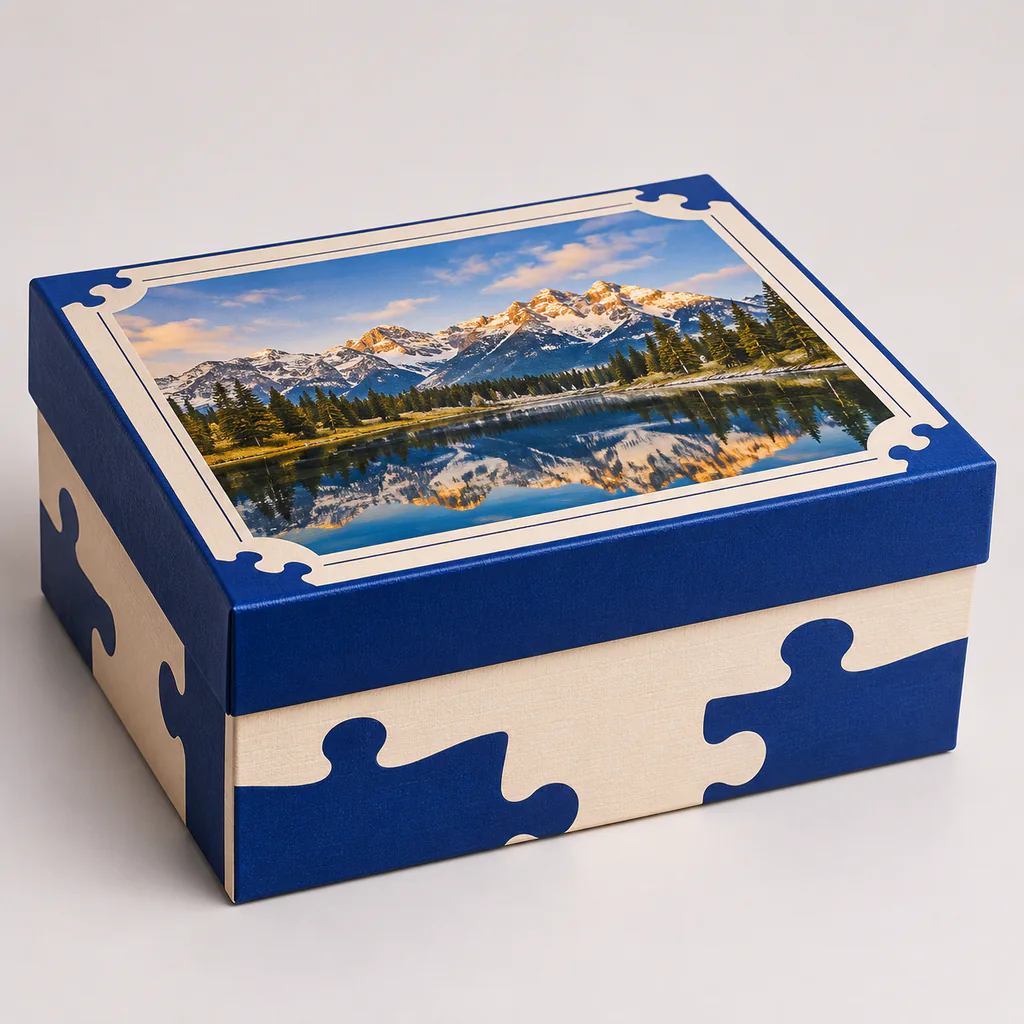
Rigid lid and base
The standard retail puzzle box.
Tech & Games
A custom puzzle box is a lid-and-base box, usually rigid board, that holds the pieces of a jigsaw puzzle and shows the finished image on its lid. The lid image is how customers choose the puzzle and how they solve it.
From $1.15 per box
Price for 1 box at 8 × 8 × 2 in (203 × 203 × 51 mm), in 1.5–2 mm grayboard, with full-color digital print on the outside.
| Quantity | Per box | Total |
|---|---|---|
| 1 | $1.15 | $1.15 |
| 100 | $1.15 | $115.00 |
| 250 | $1.15 | $287.50 |
| 500 | $1.15 | $575.00 |
| 1,000 | $1.15 | $1,150.00 |
| 2,500 | $1.15 | $2,875.00 |
| 5,000 | $1.15 | $5,750.00 |
Jigsaw boxes need a strong, square lid that shows the image at true color and enough space for the bagged pieces. 1,000-piece puzzles commonly use a box about 10 x 14 x 2 in.
Personalized and promotional puzzles are a growing market, and digital printing makes runs of a single box practical, so each puzzle can have its own lid image.
Our custom puzzle boxes are part of the retail and shelf packaging range alongside our custom product boxes. Compare all 236 custom box types, or see how Custom Boxes makes printed packaging from one box.
Two-piece lid and base · 2PC
The standard construction for custom puzzle boxes is the two-piece lid and base (2PC). A separate lid slides down over a base; made from rigid grayboard or folding board. It suits gifts, apparel and presentation sets.
The standard retail puzzle box.
A lower-cost folding version for promotions.
A paper tube for small or gift puzzles.
| Box style | Two-piece lid and base (2PC) |
|---|---|
| Rigid board | Rigid grayboard, 1,200–2,000 gsm, 1/16–3/32 in (1.5–2.5 mm) thick |
| Wrap | Printed wrap paper, 120–157 gsm |
| Print methods | Digital CMYK, Offset litho, Flexographic spot color |
| Finishes for this box | Full-color wrap print, Foil stamping, Embossing and debossing, Soft-touch lamination, Spot UV, Ribbon pulls, Custom foam or card inserts |
| Minimum order | 1 box per size and artwork |
| Digital proof | Within 24 hours of receiving artwork |
| Production time | 12–18 business days after artwork approval |
| Shipping | Free standard shipping across the US, 3–6 business days, tracked |
| Returns | Free returns within 21 days of delivery |
The size buyers ask for most is 8 × 8 × 2 in (203 × 203 × 51 mm), used for 300-piece puzzles. The smallest size listed here is 8 × 8 × 2 in (203 × 203 × 51 mm) (300-piece puzzles) and the largest is 16 × 11 × 2.5 in (406 × 279 × 64 mm) (1,500–2,000 pieces). Every box is cut to your own inside dimensions, so treat these as starting points rather than fixed sizes.
| Inside size (L × W × D) | What fits |
|---|---|
| 8 × 8 × 2 in (203 × 203 × 51 mm) | 300-piece puzzles |
| 10 × 10 × 2 in (254 × 254 × 51 mm) | 500-piece puzzles |
| 14 × 10 × 2 in (356 × 254 × 51 mm) | 1,000-piece puzzles |
| 16 × 11 × 2.5 in (406 × 279 × 64 mm) | 1,500–2,000 pieces |
Fill the bag with the intended pieces and set it on the sample base. A large pile can sit high in the middle while some pieces slip into the corners. Add the finished image sheet or booklet before checking the height. The lid should close without pressing on the bag or the printed insert.
Try a small and large puzzle if both will use the same outside box. A pad can keep a smaller bag from moving into the lid edge. Make it easy to remove so the customer can reuse the box to store the pieces after opening.
Print a full-size proof and fold it around the lid. Keep the important part of the scene away from the wrapped edge so customers can use the picture as a guide. Check whether a line in the image breaks where a corner folds. If an image sheet inside is also used as a guide, compare both versions together.
Put the name and piece count on an edge that remains visible when boxes lie in a stack. Test any applied label on the sample. It should not hide the image or cross the lid joint. Check the view from a shelf at the height where the puzzle will be sold.
Put the open base on a small table and try spreading a few pieces inside it. A low wall may make the corners easy to reach, while a deeper one can hold a full pile. Check how the lid comes off when the box rests on the table.
If staff pack the image sheet separately, make sure it stays flat after the bag goes in. Give it a place that does not get hidden underneath a support. Record the approved bag size and fold with the box so the next image can use the same fit if the pieces match.
Use the piece count and piece size to set the box volume.
Print the lid from the same file as the puzzle.
Add piece count and finished size on the lid side.
See what a box will cost to ship with the dimensional weight calculator. Unfamiliar terms on a quote? The packaging glossary explains them in plain English.
Pricing for custom puzzle boxes starts at $1.15 per box for 1 box at 8 × 8 × 2 in (203 × 203 × 51 mm), in 1.5–2 mm grayboard, with full-color digital print on the outside. The listed price is per box, in the standard specification, at any listed quantity. Larger runs, other boards and finishes are quoted.
After you send artwork, a digital proof comes back within 24 hours, and design help on the dieline is free. Production of custom puzzle boxes takes 12–18 business days once the proof is approved. Standard shipping across the US is free and takes 3–6 business days, with tracking.
For production runs in the thousands, see wholesale custom boxes, compare every format on the custom box price list, or request a quote for custom puzzle boxes.