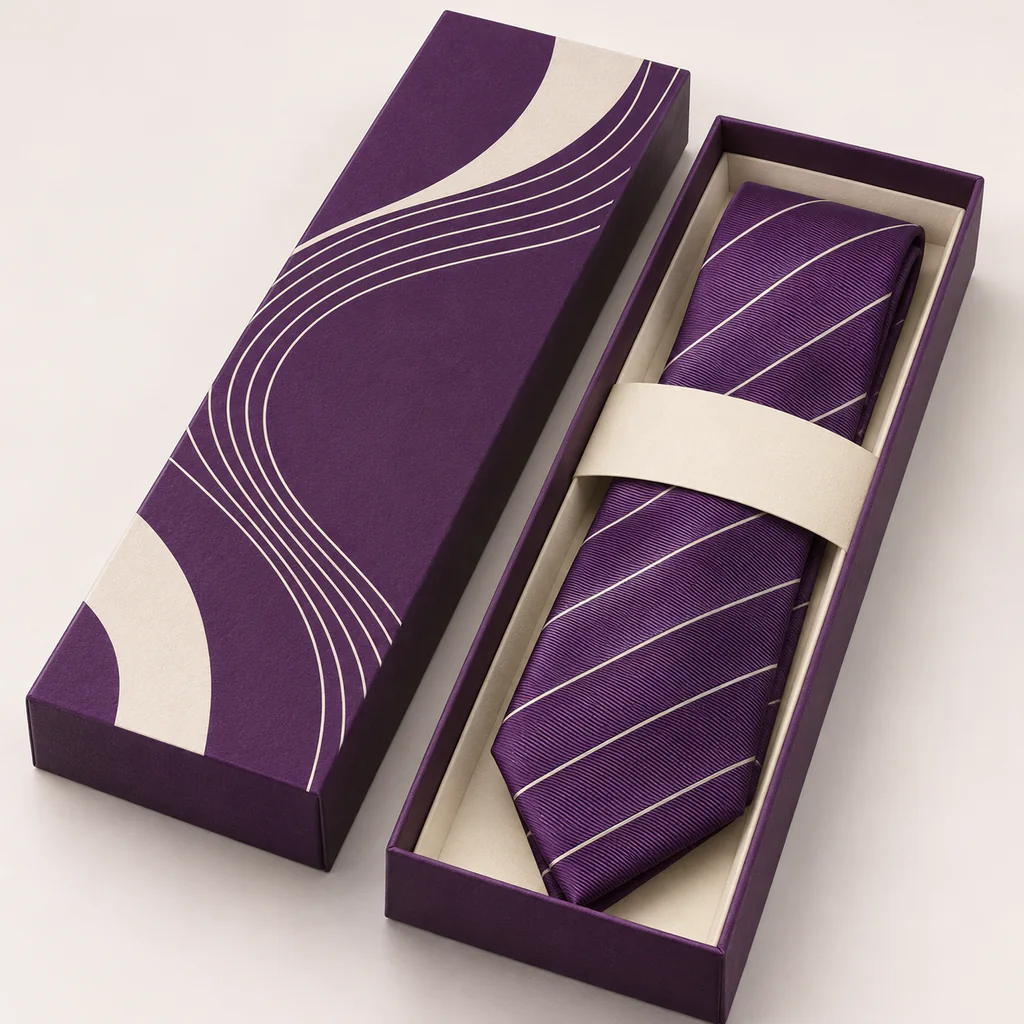
Long flat presentation box
Leave the fabric loose beneath a wide retaining strap.
Apparel and Accessories
A tie box is a narrow gift box that holds a necktie folded, loosely rolled or extended. A tray or strap keeps it in place without crushing the fabric.
From $1.29 per box
Price for 1 box at 10 × 3.5 × 1.25 in (254 × 89 × 32 mm), in Wrapped rigid board, with full-color digital print on the outside.
| Quantity | Per box | Total |
|---|---|---|
| 1 | $1.29 | $1.29 |
| 100 | $1.29 | $129.00 |
| 250 | $1.29 | $322.50 |
| 500 | $1.29 | $645.00 |
| 1,000 | $1.29 | $1,290.00 |
| 2,500 | $1.29 | $3,225.00 |
| 5,000 | $1.29 | $6,450.00 |
Presentation boxes for ties, bow ties and coordinated accessories with a fit based on the chosen fold.
A narrow roll can leave a crease in thicker cloth. A flat folded tie needs more length and headroom. Choose a packing method first and approve the insert with the most delicate material in the range.
Our custom tie boxes are part of the beauty, lifestyle and apparel packaging range alongside our custom product boxes. Compare all 236 custom box types, or see how Custom Boxes makes printed packaging from one box. Also part of our luxury packaging range.
Reverse tuck end · RTE
The standard construction for custom tie boxes is the reverse tuck end (RTE). Top and bottom tuck flaps close from opposite faces, so the carton prints and glues in one pass. It suits cosmetics, supplements and light retail products.
Leave the fabric loose beneath a wide retaining strap.
Allow sufficient diameter for the natural roll.
| Box style | Reverse tuck end (RTE) |
|---|---|
| Rigid board | Rigid grayboard, 1,200–2,000 gsm, 1/16–3/32 in (1.5–2.5 mm) thick |
| Wrap | Printed wrap paper, 120–157 gsm |
| Print methods | Digital CMYK, Offset litho, Flexographic spot color |
| Finishes for this box | Printed wrap, Foil logo, Textured paper |
| Minimum order | 1 box per size and artwork |
| Digital proof | Within 24 hours of receiving artwork |
| Production time | 12–18 business days after artwork approval |
| Shipping | Free standard shipping across the US, 3–6 business days, tracked |
| Returns | Free returns within 21 days of delivery |
The size buyers ask for most is 10 × 3.5 × 1.25 in (254 × 89 × 32 mm), used for A folded tie with loose headroom. The smallest size listed here is 10 × 3.5 × 1.25 in (254 × 89 × 32 mm) (A folded tie with loose headroom) and the largest is 4.5 × 4.5 × 3 in (114 × 114 × 76 mm) (A rolled tie). Every box is cut to your own inside dimensions, so treat these as starting points rather than fixed sizes.
| Inside size (L × W × D) | What fits |
|---|---|
| 10 × 3.5 × 1.25 in (254 × 89 × 32 mm) | A folded tie with loose headroom |
| 4.5 × 4.5 × 3 in (114 × 114 × 76 mm) | A rolled tie |
| 8 × 2.75 × 1 in (203 × 70 × 25 mm) | Compact size: A folded tie with loose headroom, travel or sample size |
| 12.5 × 4.5 × 1.5 in (318 × 114 × 38 mm) | Larger size: A folded tie with loose headroom with an insert or extra room |
Lay the tie on the intended insert and check how its widest blade rests. The keeper loop and folded lining can make one end higher. Use a light band or a recess that holds the tie without pressing on a raised seam. Close a sample and inspect the surface of the fabric after opening it.
For a bow tie, fit the bow and folded strap together. A clip or hook can project at the back and need its own space. Set the bow face up and see whether the customer can lift it by the center without pulling the strap against the tray. Check the length with any tag included.
A long tray can show a stripe or woven pattern the moment the lid lifts. A rolled presentation needs enough room for the coil to sit without spreading. Put the tie in the sample the way staff will pack it and see which face remains visible. A low tray lip can keep more of the fabric in view.
If a set includes a pocket square or cufflinks, give the hard pieces their own position. Fit the pieces and any care card before choosing the final depth. Take the tie out first and see whether the others remain in place. Change the opening order if the first item is hard to reach.
A tie box may sit with only its narrow end visible in a cabinet. Give the design a small readable identifier there if the main image is on the lid. Put a trial label on the sample and check that it stays clear of a drawer pull or the lip of a separate lid.
For a gift order, try the box with the ribbon or sleeve fitted. See where the recipient can take hold without pressing into the fabric. If the box opens lengthwise, set it on a narrow table and check the room it needs. Keep a folded sample with the notes for each tie width.
Measure with the intended fold or roll in place.
Check that it holds position without leaving a crease.
Lay the tie into the insert with its stitched edges and keeper facing as intended. Check that a band does not leave a line across the fabric. Open the sample after carrying it upright to see whether the tie is still in the intended position.
If products move inside the box, the packaging inserts guide compares card, corrugated, foam and pulp. Once your design is approved, custom box subscriptions keep the same boxes arriving on a schedule without re-proofing.
Pricing for custom tie boxes starts at $1.29 per box for 1 box at 10 × 3.5 × 1.25 in (254 × 89 × 32 mm), in Wrapped rigid board, with full-color digital print on the outside. The listed price is per box, in the standard specification, at any listed quantity. Larger runs, other boards and finishes are quoted.
After you send artwork, a digital proof comes back within 24 hours, and design help on the dieline is free. Production of custom tie boxes takes 12–18 business days once the proof is approved. Standard shipping across the US is free and takes 3–6 business days, with tracking.
For production runs in the thousands, see wholesale custom boxes, compare every format on the custom box price list, or request a quote for custom tie boxes.