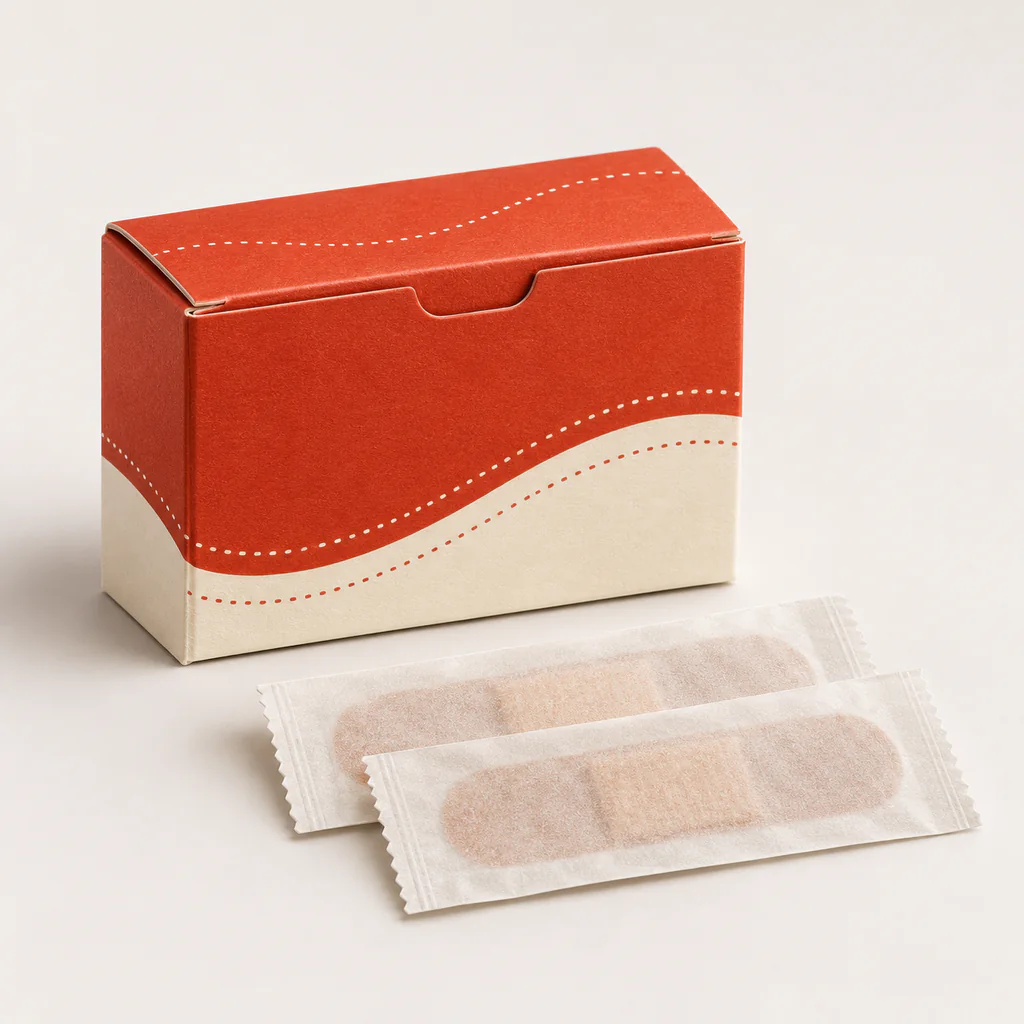
Low rectangular tuck carton
Measure the longest wrapped strip and protect the corners of its wrapper.
Health and Wellness Packaging
A bandage box is made to fit individually wrapped bandages. One construction option is a low rectangular tuck carton.
From $0.79 per box
Price for 1 box at 4 × 1.5 × 2.5 in (102 × 38 × 64 mm), in Printed folding paperboard, with full-color digital print on the outside.
| Quantity | Per box | Total |
|---|---|---|
| 1 | $0.79 | $0.79 |
| 100 | $0.79 | $79.00 |
| 250 | $0.79 | $197.50 |
| 500 | $0.79 | $395.00 |
| 1,000 | $0.79 | $790.00 |
| 2,500 | $0.79 | $1,975.00 |
| 5,000 | $0.79 | $3,950.00 |
Custom printed boxes sized for individually wrapped bandages.
Measure the longest wrapped strip and protect the corners of its wrapper.
Bandage boxes get opened at the worst moments, with a cut finger or a child waiting, so they should open with one hand and let a single strip slide out. A low tuck carton works well because the strips lie flat in a row. Mixed packs with different sizes need the largest strip to set the length, while smaller strips lie alongside it. The front usually shows the count and the strip sizes as simple outlines, which is clearer than a long list of measurements. First aid kit makers often order plain white cartons with one or two colors to keep costs low across several kit sizes.
Our custom bandage boxes are part of the retail and shelf packaging range alongside our custom product boxes. Compare all 236 custom box types, or see how Custom Boxes makes printed packaging from one box.
Reverse tuck end · RTE
The standard construction for custom bandage boxes is the reverse tuck end (RTE). Top and bottom tuck flaps close from opposite faces, so the carton prints and glues in one pass. It suits cosmetics, supplements and light retail products.
Measure the longest wrapped strip and protect the corners of its wrapper.
| Box style | Reverse tuck end (RTE) |
|---|---|
| Print methods | Digital CMYK, Offset litho, Flexographic spot color |
| Finishes for this box | Full-color exterior print, Matte or gloss finish where compatible with the board and folds |
| Minimum order | 1 box per size and artwork |
| Digital proof | Within 24 hours of receiving artwork |
| Production time | 8–12 business days after artwork approval |
| Shipping | Free standard shipping across the US, 3–6 business days, tracked |
| Returns | Free returns within 21 days of delivery |
Every order is cut to your inside dimensions, so treat these sizes as starting points.
| Inside size (L × W × D) | What fits |
|---|---|
| 4 × 1.5 × 2.5 in (102 × 38 × 64 mm) | Starting point for individually wrapped bandages. Confirm fit with a packed sample. |
| 3.25 × 1.25 × 2 in (83 × 32 × 51 mm) | Compact size: individually wrapped bandages, travel or sample size |
| 5 × 2 × 3.25 in (127 × 51 × 83 mm) | Larger size: individually wrapped bandages with an insert or extra room |
| 4 × 1.5 × 5 in (102 × 38 × 127 mm) | Double depth: individually wrapped bandages, two layers deep |
Lay the full stack in the carton the way staff will pack it. Watch how the ends overlap when the flap is shut. A wrapper corner can catch beneath the fold and bring a second strip out with the first. Try holding the closed carton in one hand and opening it with the other. Leave a free edge near the strip so the user can reach it without pressing down on the stack.
For a mixed pack, put a short wrapped strip beside the longest one. Tilt the carton gently and see whether either slips under the other. Try a folded stop or two distinct rows if the sizes are difficult to separate. Keep the stop below the grip area so the last strip remains accessible.
An assortment carton can be opened while it lies in a first aid kit. Check which side faces up and which end stays clear of other items. Put a simple outline or a name where someone can compare it with a wrapped strip. We print the text exactly as supplied. Have it reviewed before sending artwork.
If the carton needs to stand upright in a shop and lie flat in a kit, make both positions easy to identify. A clear label on the narrow end can help when the top is covered. Test a folded proof next to the other items in the kit and leave the opening clear of any applied label.
A sealed strip should slide out without rubbing a sharp cut edge. Look at the point where the longest wrapper crosses the dust flaps. Adjust the flap position if it catches a corner when the strip is lifted. Test the actual wrapper material, since an empty sample sleeve may bend more easily than a filled one.
Place the sample back in the kit after taking a strip. Check whether the closure stays seated and the remaining wrappers stay in their row. Try this with only a few strips left. A small divider that keeps them near the opening can be more useful than making the carton deeper.
Measure the longest wrapped strip and protect the corners of its wrapper.
Print the strip outlines on the panel at true size so customers can see which strips are inside before opening.
Test dispensing from both a full carton and one with a single strip left.
Still deciding? The custom box FAQ answers the questions buyers ask most before ordering. Total an order with the packaging cost calculator, or compare formats on the custom box price list.
Pricing for custom bandage boxes starts at $0.79 per box for 1 box at 4 × 1.5 × 2.5 in (102 × 38 × 64 mm), in Printed folding paperboard, with full-color digital print on the outside. The listed price is per box, in the standard specification, at any listed quantity. Larger runs, other boards and finishes are quoted.
After you send artwork, a digital proof comes back within 24 hours, and design help on the dieline is free. Production of custom bandage boxes takes 8–12 business days once the proof is approved. Standard shipping across the US is free and takes 3–6 business days, with tracking.
For production runs in the thousands, see wholesale custom boxes, compare every format on the custom box price list, or request a quote for custom bandage boxes.