Straight-tuck carton
Choose for hand packing a tube with a consistent footprint.
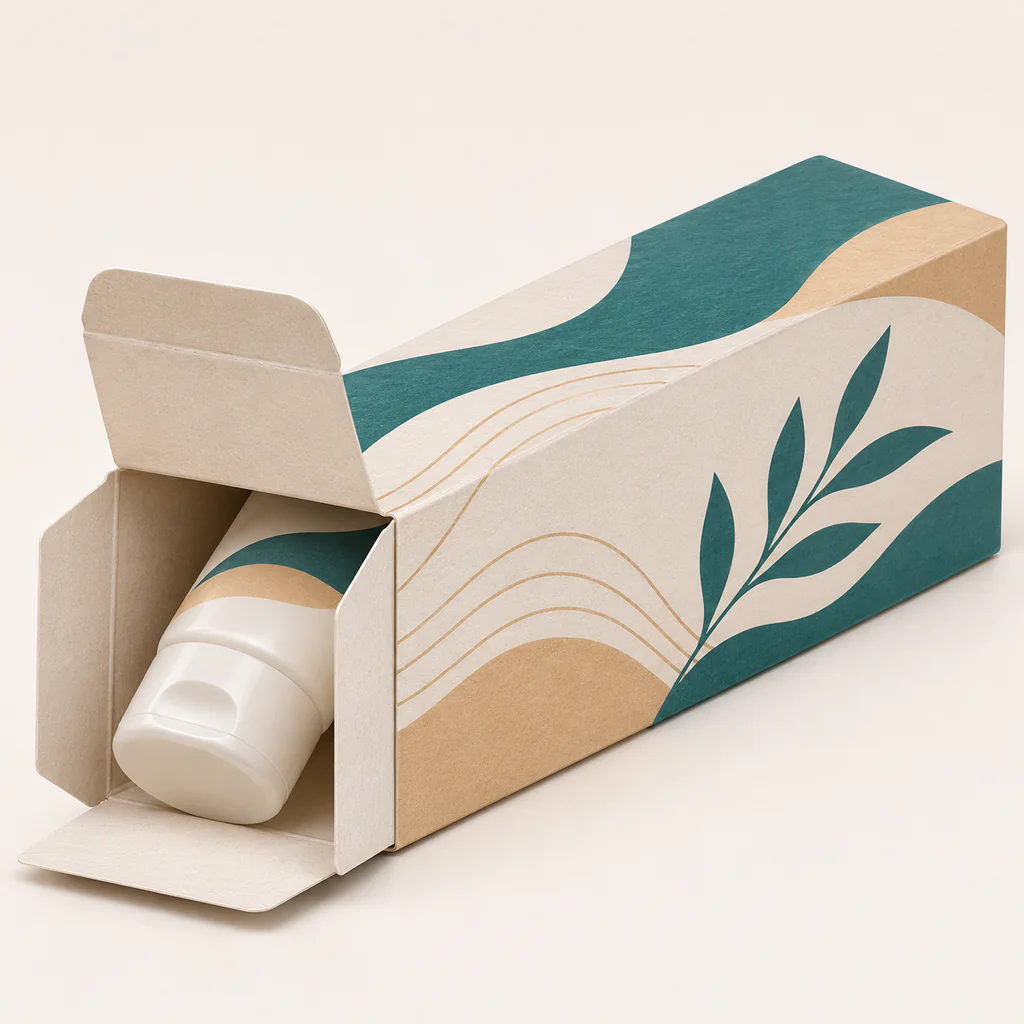
Health and Wellness Packaging
A gel tube box is a folding outer carton fitted to a sealed tube or pump. It leaves room for the closure and the wider crimped end.
From $0.72 per box
Price for 1 box at 1.5 × 1 × 5 in (38 × 25 × 127 mm), in Smooth SBS board, with full-color digital print on the outside.
| Quantity | Per box | Total |
|---|---|---|
| 1 | $0.72 | $0.72 |
| 100 | $0.72 | $72.00 |
| 250 | $0.72 | $180.00 |
| 500 | $0.72 | $360.00 |
| 1,000 | $0.72 | $720.00 |
| 2,500 | $0.72 | $1,800.00 |
| 5,000 | $0.72 | $3,600.00 |
Printed cartons for sealed topical gel tubes and similar dispensers, with measured seal clearance and variable-code space.
A filled tube can bulge after filling and can have a wide sealed edge. Measure the actual tube and verify how it slides through the opening. Keep the crimp clear of tucks or support tabs.
Our custom gel tube boxes are part of the retail and shelf packaging range alongside our custom product boxes. Compare all 236 custom box types, or see how Custom Boxes makes printed packaging from one box.
Paper tube · TUBE
The standard construction for custom gel tube boxes is the paper tube (TUBE). A wound paperboard cylinder with a lid and a base. It suits tea, cosmetics, apparel and posters.
Choose for hand packing a tube with a consistent footprint.
Hold the cap area without loading the seal.
| Box style | Paper tube (TUBE) |
|---|---|
| Paperboard | SBS paperboard, 300–400 gsm (14–24 pt) |
| Print methods | Digital CMYK, Offset litho, Flexographic spot color |
| Finishes for this box | Full-color exterior, Matte or gloss varnish |
| Minimum order | 1 box per size and artwork |
| Digital proof | Within 24 hours of receiving artwork |
| Production time | 8–12 business days after artwork approval |
| Shipping | Free standard shipping across the US, 3–6 business days, tracked |
| Returns | Free returns within 21 days of delivery |
The size buyers ask for most is 1.5 × 1 × 5 in (38 × 25 × 127 mm), used for compact capped tube. The smallest size listed here is 1.5 × 1 × 5 in (38 × 25 × 127 mm) (compact capped tube) and the largest is 2 × 1.5 × 7 in (51 × 38 × 178 mm) (larger tube with a wider crimp). Every box is cut to your own inside dimensions, so treat these as starting points rather than fixed sizes.
| Inside size (L × W × D) | What fits |
|---|---|
| 1.5 × 1 × 5 in (38 × 25 × 127 mm) | Compact capped tube |
| 2 × 1.5 × 7 in (51 × 38 × 178 mm) | Larger tube with a wider crimp |
| 1.25 × 0.75 × 4 in (32 × 19 × 102 mm) | Compact size: compact capped tube, travel or sample size |
| 2 × 1.25 × 6.25 in (51 × 32 × 159 mm) | Larger size: compact capped tube with an insert or extra room |
Use a filled sample with the cap fitted and the crimp in its final shape. A broad crimp can catch on an inner tab even when the body has enough space. Try loading from each end to see which gives staff a straight path. Keep a small margin where the crimp passes the flaps so it can move without being folded.
Place the loaded carton upright and check where the tube rests. A cap with a narrow foot can make the tube lean if it lands on a flap seam. A folded seat can support the cap or the shoulder, depending on the intended orientation. Try opening the sample after storing it on its side.
A folded leaflet can fit against a tube and still make the closing end too thick. Fit both in the sample in their intended order. Place the leaflet where a user can lift it without pressing the tube. A separate tool should have a clear spot that keeps it from catching the cap as either item comes out.
Check the full pack with the largest cap in the range if several tubes use one carton. A small change in the cap can move the tube enough to cover the leaflet grip. Fit the shortest tube too, since an open gap may let a tool slip behind it. Note the order of the parts on the packing reference.
Set the sample the way it will move through the coding station. Mark the face the equipment can reach and keep the code area away from folds. Check the carton after it has been filled to see whether the surface still lies flat. We print the text exactly as supplied. Have it reviewed before sending artwork.
If boxes are picked from a rack, put the sample in that position and see which end is visible. A short code or name can stay readable after closing if it is placed above the tucked part. Apply a test label to see whether it reaches into the area the user needs to grip. Save that sample for future tube sizes.
Include the widest bulge, cap and crimp.
Test adhesion or readability with the chosen coating.
Place the folded leaflet or tool in its final position, then slide the sealed tube into the sample. Look for a pocket edge that catches the cap and shifts the insert. If the same outer size serves different tubes, repeat the trial with the broadest cap.
Unfamiliar terms on a quote? The packaging glossary explains them in plain English. No artwork yet? Our packaging design services team builds print-ready files on your dieline.
Pricing for custom gel tube boxes starts at $0.72 per box for 1 box at 1.5 × 1 × 5 in (38 × 25 × 127 mm), in Smooth SBS board, with full-color digital print on the outside. The listed price is per box, in the standard specification, at any listed quantity. Larger runs, other boards and finishes are quoted.
After you send artwork, a digital proof comes back within 24 hours, and design help on the dieline is free. Production of custom gel tube boxes takes 8–12 business days once the proof is approved. Standard shipping across the US is free and takes 3–6 business days, with tracking.
For production runs in the thousands, see wholesale custom boxes, compare every format on the custom box price list, or request a quote for custom gel tube boxes.