Shallow corrugated mailer
Choose for direct delivery after testing the loaded panel span.
Electronics Packaging
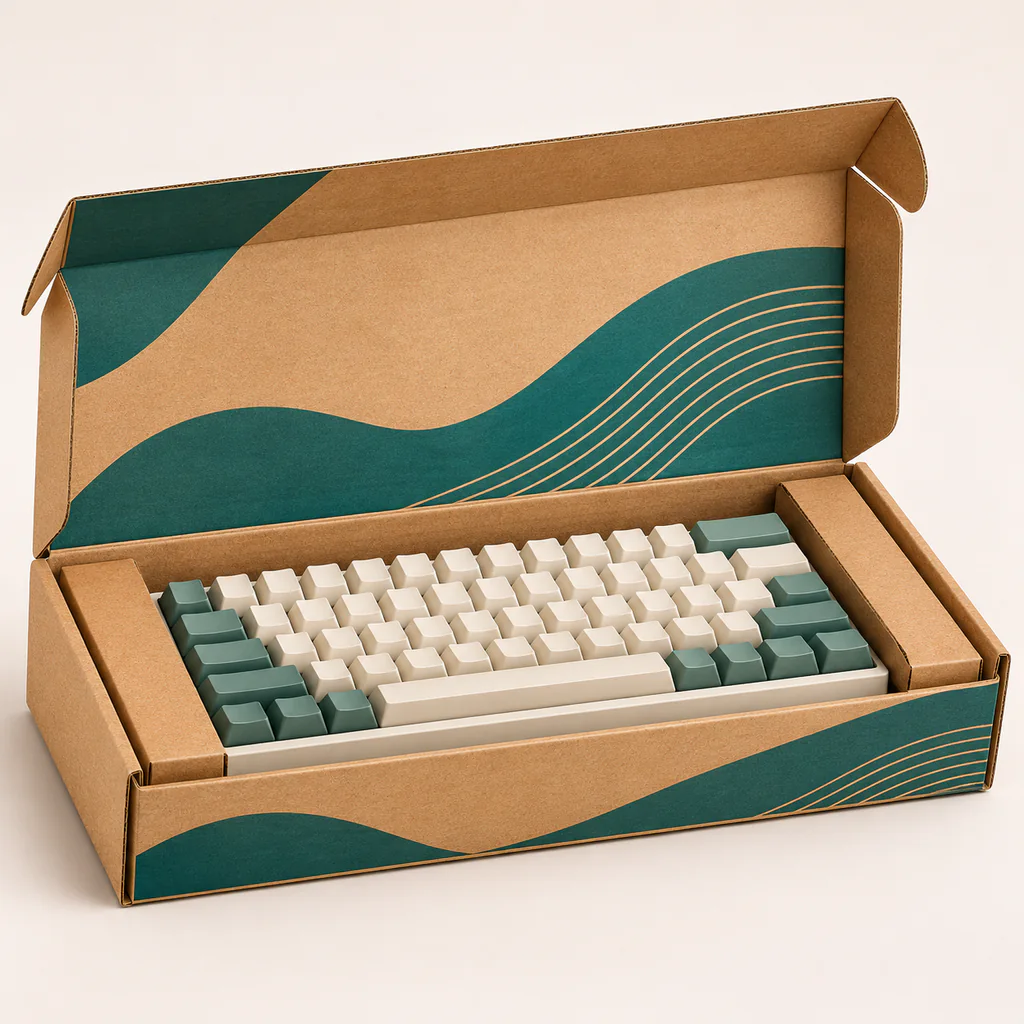
A keyboard box is a long, shallow pack with end supports that hold the keyboard’s base and keep pressure off its keys and switches.
From $1.19 per box
Price for 1 box at 13 × 6 × 2.5 in (330 × 152 × 64 mm), in E-flute or B-flute corrugated, with full-color digital print on the outside.
| Quantity | Per box | Total |
|---|---|---|
| 1 | $1.19 | $1.19 |
| 100 | $1.19 | $119.00 |
| 250 | $1.19 | $297.50 |
| 500 | $1.19 | $595.00 |
| 1,000 | $1.19 | $1,190.00 |
| 2,500 | $1.19 | $2,975.00 |
| 5,000 | $1.19 | $5,950.00 |
Long cartons for full-size, compact and mechanical keyboards with space for cables, feet and controls.
A full-size board with number pad needs a longer shell than a compact layout. Keycap profile changes clearance even if the footprint matches. Capture the keyboard by its base edges and separate the cable or removable receiver.
Our custom keyboard boxes are part of the retail and shelf packaging range alongside our custom product boxes. Compare all 236 custom box types, or see how Custom Boxes makes printed packaging from one box.
Roll end tuck top mailer · FEFCO 0427
The standard construction for custom keyboard boxes is the roll end tuck top mailer (FEFCO 0427). A one-piece corrugated mailer with rolled double walls and a tuck lid; no tape needed. It suits ecommerce, subscriptions and gift shipping.
Choose for direct delivery after testing the loaded panel span.
Use a removable tray and printable sleeve for retail.
| Box style | Roll end tuck top mailer (FEFCO 0427) |
|---|---|
| Strength grades | 32 ECT single wall: 200 psi burst, up to 65 lb (29 kg); 44 ECT single wall: 275 psi burst, up to 95 lb (43 kg); 48 ECT double wall: 275 psi burst, up to 100 lb (45 kg) |
| Print methods | Digital CMYK, Offset litho, Flexographic spot color |
| Finishes for this box | Full-color exterior, Matte or gloss varnish |
| Minimum order | 1 box per size and artwork |
| Digital proof | Within 24 hours of receiving artwork |
| Production time | 8–12 business days after artwork approval; rush 5–7 business days |
| Shipping | Free standard shipping across the US, 3–6 business days, tracked |
| Returns | Free returns within 21 days of delivery |
The size buyers ask for most is 13 × 6 × 2.5 in (330 × 152 × 64 mm), used for compact keyboard. The smallest size listed here is 13 × 6 × 2.5 in (330 × 152 × 64 mm) (compact keyboard) and the largest is 20 × 8 × 3 in (508 × 203 × 76 mm) (full-size layout with a separated cable). Every box is cut to your own inside dimensions, so treat these as starting points rather than fixed sizes.
| Inside size (L × W × D) | What fits |
|---|---|
| 13 × 6 × 2.5 in (330 × 152 × 64 mm) | Compact keyboard |
| 20 × 8 × 3 in (508 × 203 × 76 mm) | Full-size layout with a separated cable |
| 10.5 × 4.75 × 2 in (267 × 121 × 51 mm) | Compact size: compact keyboard, travel or sample size |
| 16.25 × 7.5 × 3.25 in (413 × 191 × 83 mm) | Larger size: compact keyboard with an insert or extra room |
Place the keyboard in the carton with its feet folded and any cover fitted. Measure the highest key and the points where the base can carry support. Fit end blocks around the chassis while leaving the keys and knobs clear. Check the space above the middle of the board as well as over the ends.
Close the sample and watch for pressure at the long edges. A narrow keyboard can slide beneath a support set for a wider case. Test the longest and narrowest layouts separately. If they share a shell, make the insert for each one easy for staff to identify.
Give the cord enough room for the coil the team actually packs. If the cable is attached, provide a path out of the chassis that does not force a tight turn. A separate pocket can keep the plug or receiver from moving against the keys after the box is carried on its end.
Try removing the keyboard while its accessories are still in place. A pull tab can help lift a tray without bending the board. If a key tool comes with the set, position it where it will not slip below a support or be thrown away with the packing material.
Try a filled carton in a stack like the one used in storage. Put the layout name where the picker can see it without sliding the box out. Keep any applied label clear of the opening tab. Check the print with the sample upright and on its side.
A long printed face can show where a crease makes a border uneven. Fold a proof and check the center and both ends with the keyboard loaded. Leave enough clearance to lift the box out of its outer carton by the base rather than by a tuck or end flap.
Include the tallest controls and keycaps.
Check for bowing or contact with keys under normal handling.
Fit the keyboard in its sample with any knob, key cover and cable in place. Watch the area above the tallest point as the lid closes. Check the carton again after placing it inside the planned outer box so no pad has moved toward that control.
Still deciding? The custom box FAQ answers the questions buyers ask most before ordering. Total an order with the packaging cost calculator, or compare formats on the custom box price list.
Pricing for custom keyboard boxes starts at $1.19 per box for 1 box at 13 × 6 × 2.5 in (330 × 152 × 64 mm), in E-flute or B-flute corrugated, with full-color digital print on the outside. The listed price is per box, in the standard specification, at any listed quantity. Larger runs, other boards and finishes are quoted.
After you send artwork, a digital proof comes back within 24 hours, and design help on the dieline is free. Production of custom keyboard boxes takes 8–12 business days once the proof is approved. If the date is tight, rush production takes 5–7 business days on most corrugated mailer and shipping boxes. Standard shipping across the US is free and takes 3–6 business days, with tracking.
For production runs in the thousands, see wholesale custom boxes, compare every format on the custom box price list, or request a quote for custom keyboard boxes.