Single case pocket
Fit the closed case and leave its hinge clear.
Electronics Packaging
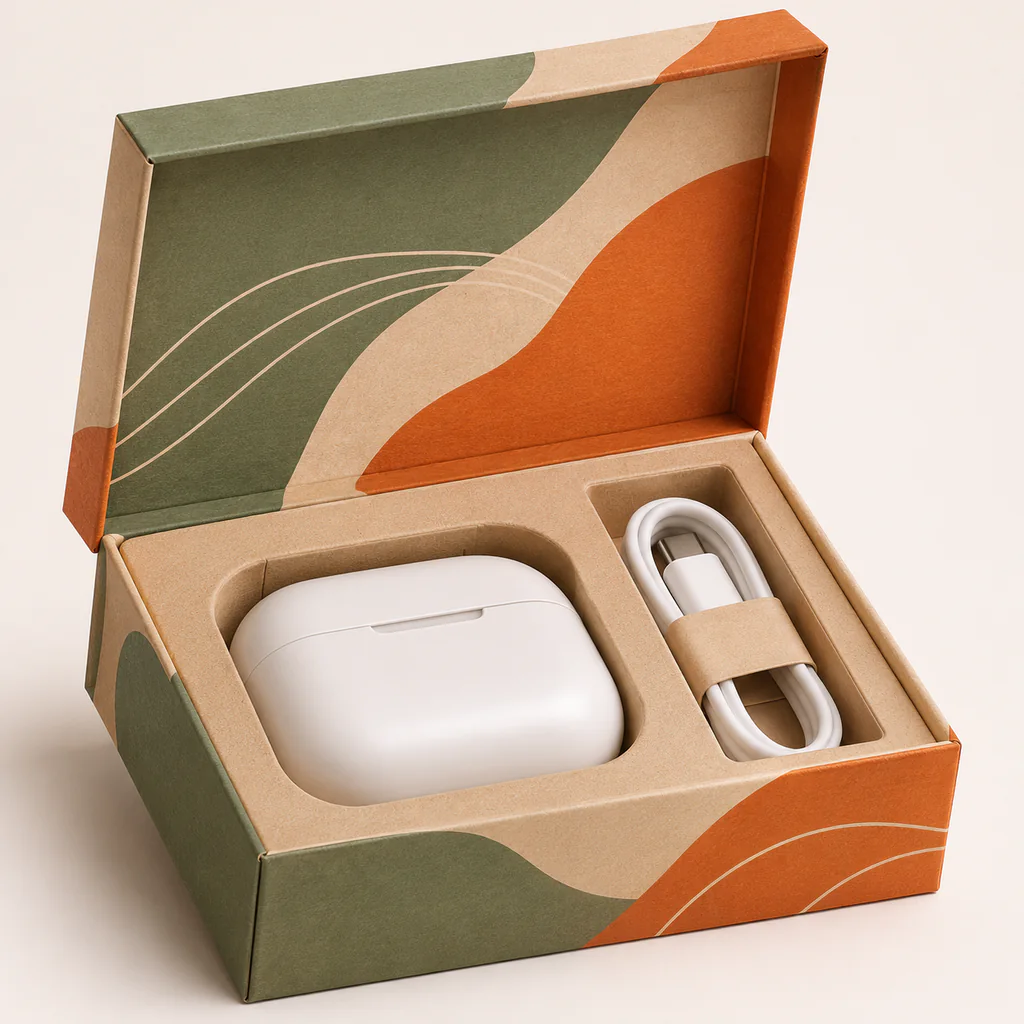
An earbud box is a compact retail carton or rigid case with a fitted pocket for a charging case and separate space for any cable or tips.
From $1.19 per box
Price for 1 box at 3 × 3 × 1.5 in (76 × 76 × 38 mm), in SBS carton board, with full-color digital print on the outside.
| Quantity | Per box | Total |
|---|---|---|
| 1 | $1.19 | $1.19 |
| 100 | $1.19 | $119.00 |
| 250 | $1.19 | $297.50 |
| 500 | $1.19 | $595.00 |
| 1,000 | $1.19 | $1,190.00 |
| 2,500 | $1.19 | $2,975.00 |
| 5,000 | $1.19 | $5,950.00 |
Compact printed boxes for wireless earbuds, built around the charging case, hinge and removable accessories.
A glossy charging case can show scuffs before its cardboard box looks damaged. Hold it on suitable contact points and use a lift tab so buyers do not scrape it against a tight tray.
Our custom earbud boxes are part of the retail and shelf packaging range alongside our custom product boxes. Compare all 236 custom box types, or see how Custom Boxes makes printed packaging from one box.
Reverse tuck end · RTE
The standard construction for custom earbud boxes is the reverse tuck end (RTE). Top and bottom tuck flaps close from opposite faces, so the carton prints and glues in one pass. It suits cosmetics, supplements and light retail products.
Fit the closed case and leave its hinge clear.
Separate cables and spare tips below the first reveal.
| Box style | Reverse tuck end (RTE) |
|---|---|
| Rigid board | Rigid grayboard, 1,200–2,000 gsm, 1/16–3/32 in (1.5–2.5 mm) thick |
| Wrap | Printed wrap paper, 120–157 gsm |
| Paperboard | SBS paperboard, 300–400 gsm (14–24 pt) |
| Print methods | Digital CMYK, Offset litho, Flexographic spot color |
| Finishes for this box | Full-color exterior, Matte or gloss varnish |
| Minimum order | 1 box per size and artwork |
| Digital proof | Within 24 hours of receiving artwork |
| Production time | 8–12 business days after artwork approval |
| Shipping | Free standard shipping across the US, 3–6 business days, tracked |
| Returns | Free returns within 21 days of delivery |
The size buyers ask for most is 3 × 3 × 1.5 in (76 × 76 × 38 mm), used for one compact charging case. The smallest size listed here is 3 × 3 × 1.5 in (76 × 76 × 38 mm) (one compact charging case) and the largest is 4 × 3.5 × 2 in (102 × 89 × 51 mm) (case and cable in separate positions). Every box is cut to your own inside dimensions, so treat these as starting points rather than fixed sizes.
| Inside size (L × W × D) | What fits |
|---|---|
| 3 × 3 × 1.5 in (76 × 76 × 38 mm) | One compact charging case |
| 4 × 3.5 × 2 in (102 × 89 × 51 mm) | Case and cable in separate positions |
| 2.5 × 2.5 × 1.25 in (64 × 64 × 32 mm) | Compact size: one compact charging case, travel or sample size |
| 3.75 × 3.75 × 2 in (95 × 95 × 51 mm) | Larger size: one compact charging case with an insert or extra room |
Place the closed case in the tray with the hinge and charging port in their intended positions. A case can taper toward the top and still be widest near the seam. Leave enough space to grasp the lower shell without pulling on the lid. Fit the sample with any protective film applied.
Try a case with its surface facing the way it will be displayed. Check for rubbing as it goes in and comes out. A pull ribbon can lift a smooth case evenly if it sits across the base. Test whether the ribbon stays reachable after the lid is closed.
A small cable can fit a short cavity until the connector is turned sideways. Pack the cable in its final coil and give the connector a stop so it cannot work under the case tray. If a strip of spare tips comes in a bag, fit it with its sealed edge clear of the lid.
For a box with a lower tray, open the sample and see which piece should come out first. Give the tray a visible grip if the cable or instructions are underneath it. Check that the small bag does not fall into the empty case recess as the tray is lifted.
Set the cartons in the order staff pick them for dispatch. Make sure the color or version is visible on an end that stays clear when they stack. If a store label is applied, use its real dimensions to check that it does not cover the opening point.
Look at the case and carton together after the proof is folded. A light tray can show where a dark case touches it. Adjust the contact points if needed. Keep the approved tray and the actual case dimensions together so a change to the hinge or port can be tested before reordering.
Include lid hinge and port projections.
Check the actual battery configuration with the carrier.
Put the ribbon beneath the charging case with its protective film already applied. Close the box and reopen it to see whether the ribbon stays within reach. Pull from the intended end and check that the case lifts level without turning into the hinge or rubbing the tray wall.
Turn the cable in its well until the connector lies below the tray edge. Close the full sample, then carry it on its side and open it again. Check that the connector has not moved beneath the case or pushed a small accessory into the opening.
Handling marks such as this-way-up or fragile can be printed next to your logo; see shipping box symbols. See what a box will cost to ship with the dimensional weight calculator.
Pricing for custom earbud boxes starts at $1.19 per box for 1 box at 3 × 3 × 1.5 in (76 × 76 × 38 mm), in SBS carton board, with full-color digital print on the outside. The listed price is per box, in the standard specification, at any listed quantity. Larger runs, other boards and finishes are quoted.
After you send artwork, a digital proof comes back within 24 hours, and design help on the dieline is free. Production of custom earbud boxes takes 8–12 business days once the proof is approved. Standard shipping across the US is free and takes 3–6 business days, with tracking.
For production runs in the thousands, see wholesale custom boxes, compare every format on the custom box price list, or request a quote for custom earbud boxes.